Every fuselage and spar on this site starts as a flat strip and four fold lines. The whole trick is one rule: mark your dimension four times, then cut 3/16″ channels inside the second and fourth spaces. Do that, and the strip closes into a crisp, square tube on the first try — no crushed corners, no "why is it wider than I marked."
To fold foam board into a square tube, make parallel cuts one foam-thickness apart along each fold line, peel the foam strip out of the channel, and leave the far paper face intact as the hinge. Fold the flat into a box and glue it square — a stiff, light fuselage from one sheet.
A flat strip of foam board flops. Fold that same strip into a box tube and it suddenly resists bending in every direction — same material, same weight, completely different structure. That's why the 30-inch trainer's fuselage is one folded 2½″ tube, and why a folded C-channel makes a wing spar stiffer than a solid strip three times its weight. If it's a wing you're stiffening, the wing spar guide covers which spar your span actually needs and where in the chord it goes.
The catch is the fold itself. Foam board is ≈3/16″ thick, and a plain fold has to bend around that thickness: the paper cracks, the corner rounds over, and each face comes out wider than you marked. The fix is to take the foam out of the corner's way — a channel: a 3/16″-wide strip where you remove the near paper and the foam but leave the far paper untouched. The surviving paper becomes the hinge, the neighboring face nests into the empty channel, and the corner closes dead square at exactly the size you marked.
Cross-section view. The yellow bands are the 3/16″ channels; when each corner folds, the next face drops into the empty channel and the corner closes square. The far paper is the hinge — never cut through it.
This 30-minute plane's fuselage is built with exactly this channel cut — two parallel cuts a foam-thickness apart, the strip of foam peeled out, the far paper left intact as the hinge. The full build is here: How to Build an RC Airplane in 30 Minutes.
Enter the tube you want and get every ruler mark, in order, ready to take to the board. Works for the square box (fuselages) and the three-sided C-channel (spars).
Channels are drawn inside the second and fourth spaces (second space only, for a C-channel). Cut channel edges with a straightedge, remove the foam, leave the far paper.
If you'd rather not mark anything at all, the 30-inch one-hour trainer CAD plan set draws its fuselage — a 21″ flat that folds into a 1½″ box tube — at true 1:1, so you cut on printed lines instead of running a ruler down the board.
The 30-inch trainer's fuselage is exactly this fold at 2½″ — and the whole airplane is an afternoon.
The airplane this site is built around, as plans or cut for you, and the small parts I use on every build.
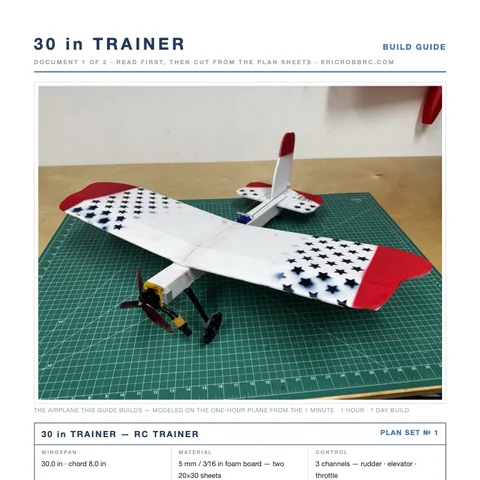 ER Sparrow Mk II Pre-Cut KitEvery foam part laser-cut and scored, the motor mount, the skewers, and the plans. Add your electronics and glue.$29.99See the kit →
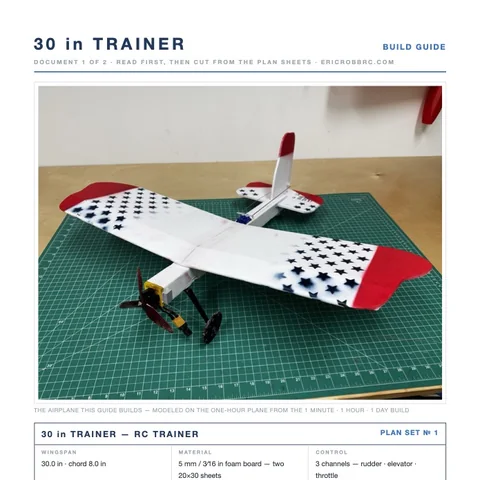 ER Sparrow Mk II PlansTrue-1:1 cutting templates and the 8-page build guide for the 30-inch one-hour trainer. Print at home or at a print shop.$8Get the plans →
 Servo Lead Heat-Shrink LabelsAIL, ELE, RUD, THRO and the rest, shrunk onto the lead so the receiver bay reads itself. Four packs.from $19.99See the label kit →
