For schools, homeschool groups, STEM programs and RC clubs
Classroom Flight Lab
A design-build-fly engineering project a group can actually finish. Everyone designs an airplane, works out what will make it fly, builds it out of a few dollars of foam board, predicts what it will do, and then finds out — because the last step is a real airplane leaving the ground.
Built around a 30-inch trainer Eric has built and flown on camera, not a design invented for a worksheet.
Two ways to run this
Teach it yourself. The instructor guide and the student worksheets are written and ready — 13 pages and 8 pages, for someone who has never flown a radio-controlled airplane. What is in them, and what it costs →
Or have me come and teach it. I run the sessions with your group and we put the airplane in the air on the last day. Travel, dates and group size decide the cost, so that one is a conversation rather than a checkout. Ask about a visit →
Everything else on this page — the airplane, the tools, the reference material — is free and stays free, with or without either of those.
What the project is
One airplane, six stages, sized to whatever time you have. The engineering is not hidden inside the build — it sits around it, in the decisions the group has to make and defend before anything gets cut.
Design the airplaneWing area, span and chord, and what each decision costs you elsewhere. Teams size their own wing, then compare it with one that flew.The Airplane Designer →
Choose the power systemWhy a motor, a propeller, a battery and a speed controller have to be chosen together. Where the current actually goes, and what happens to a controller when you get it wrong.Checklist Builder · Parts Matcher
Wire itA real electrical system a student can hold: a power source, a controller, actuators and a signal. The order you connect it in is not arbitrary, and the reason why is teachable.The Wiring Designer →
Predict the numbersWing loading, stall speed, thrust, flight time, balance point. Every team writes down a prediction before the airplane is finished. This is the part that makes it engineering rather than craft.The calculators →
Build and checkAbout two hours of cutting and gluing from a 1:1 template, then a preflight that finds the mistakes that would otherwise end the project in three seconds.The build guide →
Fly it, then measure what happenedWeigh it, fly it, write down the result next to the prediction, and label which numbers were calculated and which were measured. Teams compare against real airplanes in the setup database.The setup database →
The curriculum
Two PDFs. Every specification in them is copied from the ER Sparrow Mk II plans — the same plan set your students cut the airplane from — so the guide and the plans can never quietly disagree. What your own airplane weighs and where it balances are for your group to measure, and that is what Worksheets 5 and 6 are for.
Classroom Flight Lab — Instructor Guide and Student Worksheets
Instructor Guide, 13 pages. What to buy and print, how the six sessions fit together, a page per session with the teaching beats and what to watch for, safety, assessment, troubleshooting, and the airplane’s reference numbers on one page for the bench.
Student Worksheets, 8 pages. One per session, plus a front and back for the wiring sheet. Every number a student writes gets labelled calculated or measured, and the predictions are signed before the airplane is finished.
Written for no RC experience. The guide assumes you have never flown one and says so on page 1.
Printable and copyable for every student in your group, every term, for as long as you like.
What is in the guide
p2–3 Before session 1 — buy list, print list, flying site
p4 How the six sessions fit together
p5 Session 1 — Design the airplane
p6 Session 2 — Choose the power system
p7 Session 3 — Wire it
p8 Session 4 — Predict the numbers
p9 Session 5 — Build and check
p10 Session 6 — Fly and measure
p11 Safety and the field briefing
p12 Assessment rubric and troubleshooting
p13 Reference numbers and licence
The spine of all six sessions is one habit: predict it, then measure it, then label which is which. That is the thing worth teaching, and it is the thing the worksheets grade.
$65one instructor, one group, unlimited students and terms
You also need something to cut the airplane from: the plans at $8 once, the pre-cut kit at $29.99 plus shipping per airplane, or the free build article if you would rather not print templates.
Have me come and teach it
I will run the sessions with your group in person, bring the flying gear, and we put an airplane in the air on the last day. If the weather beats us, the flying day moves — that gets agreed in writing before anyone books anything.
What a visit involves
I am one person with a van, not a touring company, so this is deliberately honest about what it takes. Everything below is settled by email before there is any commitment on either side.
Shape
Anything from a single full day to a session a week across a term. Most groups want one day of building and one of flying.
What I bring
Transmitters, batteries, a charger, spare propellers, tools, and enough spare parts that one crash does not end the day.
What you provide
The room, the students, and an open space to fly that we agree on in advance. I will look at a satellite view of it with you before the date.
What it costs
A day rate plus travel, and materials if you would rather I brought them. Distance is the biggest variable, which is exactly why there is no price on this page — a quote for a group two hours away would be a lie to a group on the other side of the country.
Insurance and clearance
Tell me what your institution requires and I will tell you straight away whether I can meet it. I would rather lose the booking than turn up unable to satisfy your policy.
The curriculum
Included with a visit. If you already bought it, it comes off the invoice.
It goes straight to me. No obligation, and I will tell you if your group is somewhere I realistically cannot reach.
What exists today, and what has to be made
Being clear about this is the whole reason the page is honest enough to be worth reading.
Already real and tested
The airplane — a 30-inch foam-board trainer Eric built and flew, with measured dimensions and a published parts list.
The plans: 1:1 printable templates, a full-size sheet and an 8-page illustrated guide. And the pre-cut kit: the same airplane laser-cut, one per box.
Eight free tools that do the parts of the job which normally need experience.
A database of real setups, each labelled by whether it was estimated, specified, measured or flown.
Plain-English explanations of lift, wing loading, thrust, balance and power, written for people who have never done this.
The instructor guide and the student worksheets above — written, laid out and ready to print.
Not made yet — tell me if you need it
A class set of pre-cut airplanes at one price. The single-airplane kit exists; a class-set price does not yet, so ask with the number you need.
A mapping to a specific syllabus or standards framework. I will not claim an alignment I have not done.
A bulk electronics kit priced for a whole class rather than one airplane.
Translations, or a version sized for a single two-hour workshop.
Whatever your group needs that is not on either of these lists.
What it costs
The materials figures are the real ones from the build this is based on. The rest are what you can optionally buy from me, priced separately — there is no bundle, and every tool stays free.
Item
Cost
Reusable?
Airframe — foam board, glue, skewers
$3–8 per airplane
No. This is the part you buy again.
A complete first set, including radio and charger
About $140
The radio and charger carry over to every plane and every term.
Optional. Depends on where you are and how long you want.
Every tool on the site
Free
No account, no login, works on a school network.
The first term costs real money. The ones after it cost foam, because the expensive parts move into the next airplane.
If you have never flown an RC airplane
That is the case this is designed around, and it is the reason the project is built on a tested airplane rather than a blank sheet. Every decision that normally needs experience already has a published answer you can check: the dimensions come from a plane that flew, the balance point is measured, and the parts are matched to each other. The tools do the sizing arithmetic and explain what they did. There is a free troubleshooter for the moment something will not fly, and a browser simulator so the first landing attempt is not the first landing attempt.
What is genuinely on you: somewhere safe and open to fly, a sensible rule about who holds the transmitter, and the local rules for flying a model aircraft where you are. That last one varies by country and by site, and it is the one thing this project cannot answer for you.
Get in touch
One form, three things you might want. It goes straight to Eric, it is never published, and it is not a mailing list.
Common Questions
Questions instructors ask
No, and that is the main design constraint. The airplane is one Eric has built and flown on camera, so the dimensions, the parts and the balance point are already settled and published. The free tools on the site do the parts of the job that normally need experience: matching a motor to a propeller and a battery, drawing the wiring, finding the balance point, and diagnosing a plane that will not fly. Your job is running the room, not becoming an RC expert.
The airframe is the cheap part: three to eight dollars of foam board per airplane. A complete first set of electronics is around $140, and the radio and charger in that figure carry over to every plane and every term afterwards. So the first term costs real money and the ones after it cost foam.
The airplane itself is about two hours of building for someone following the guide. As a taught project it stretches to fill whatever you have, because the engineering sits around the build rather than inside it: sizing the wing, choosing the power system, working out the balance point, predicting the flight and then measuring what actually happened.
Why a wing makes lift and what wing loading does to how an airplane behaves. Why a propeller's power demand rises with the fourth power of its diameter, which is the reason adding a cell burns a speed controller. Where the centre of gravity has to be and what happens either side of it. How to size a battery from a current draw. And the habit that matters most: writing down what you predicted, then measuring what happened, and labelling which is which.
Two PDFs: a 13-page instructor guide and 8 pages of student worksheets, licensed to one instructor at one school, club or group, with as many students and as many terms as you like. You do not get the plans in that price — those are the separate $8 plans, or you can build straight from the free article. Physical parts are a separate purchase too: the pre-cut kit, $29.99 plus shipping per airplane. You also do not get physical parts; nothing is shipped.
Yes, and it is the normal way this gets bought. Choose “send me an invoice” on the form above and say what your finance office needs on it — a purchase-order number, a W-9, a quote first, a specific billing address. I email the invoice, and the download link goes out the moment it is paid. If your process needs the files before payment clears, say so and I will usually send them anyway.
A day rate plus travel, quoted per group, because distance is the largest part of the number and a price on a web page would be wrong for almost everyone who read it. Ask on the form above with your rough location and dates and you will get a real figure, with no obligation. If you are somewhere I realistically cannot reach, I will tell you that straight away rather than quote you something absurd.
Possibly, and that is one of the things worth finding out. The plan set already includes a machine-ready cutting file, so a school with a laser cutter can cut a class set itself. Whether Eric should cut and ship kits depends entirely on how many groups need that rather than the file.
In the meantime
Everything here is already free to use
You do not need permission or a product to run this with a group. The build guide, the tools and the reference pages are open. If you try it, I would genuinely like to hear how it went.
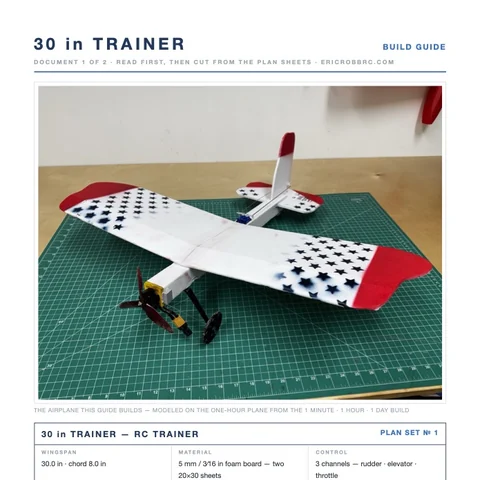 ER Sparrow Mk II Pre-Cut KitEvery foam part laser-cut and scored, the motor mount, the skewers, and the plans. Add your electronics and glue.$29.99See the kit →
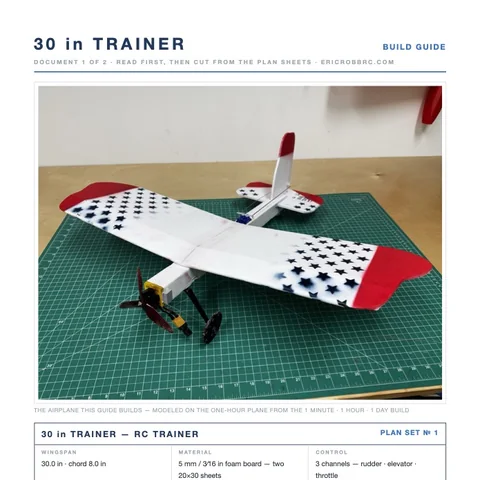 ER Sparrow Mk II PlansTrue-1:1 cutting templates and the 8-page build guide for the 30-inch one-hour trainer. Print at home or at a print shop.$8Get the plans →
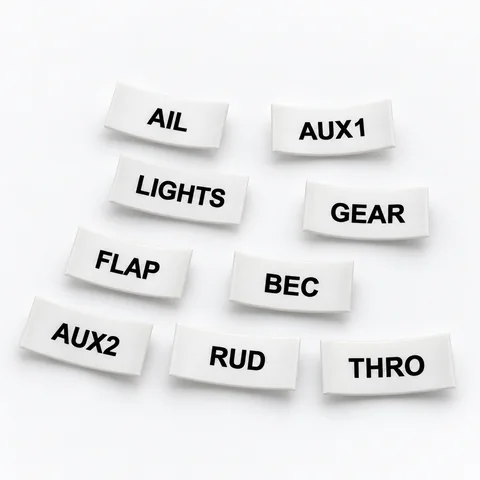 Servo Lead Heat-Shrink LabelsAIL, ELE, RUD, THRO and the rest, shrunk onto the lead so the receiver bay reads itself. Four packs.from $19.99See the label kit →
