These aren't a random pile of calculators — they're one system. Design the airplane, choose compatible electronics, wire it correctly, check the setup, diagnose problems, and document the finished build. Each step hands off to the next. Six connected airplane-building steps, plus a specialist LED Compatibility Checker — free, no signup, and everything works on your phone at the field.
I want to…
Six connected steps — design it, choose the electronics, wire it, run the numbers, check the setup, document the build. Each hands off to the next.
Start an airplane here and every tool below keeps its numbers — design, electronics, wiring, balance, preflight, and what happened when you flew it. Keep as many aircraft as you like. No account, stored in your browser.
Open my builds → ★ FlagshipEnter wingspan, flying style, battery, and motor. Get your CG location, wing loading, thrust plan, and servo placement — with a to-scale 2D plan, a spinnable 3D view, and a buyable parts list.
Design my airplane →Answer a few questions about your plane and get a complete, buyable parts checklist — motor, ESC, battery, servos, and radio, all sized to work together.
Build my checklist →Already own a motor, a prop or an ESC? Enter what you have and it solves the rest — ESC amps, prop size, cells, capacity and C rating — with the current draw, flight time and the warnings that save a controller.
Match my parts → ★ FlagshipPick your battery, ESC, receiver, and servos — see a color-coded wiring diagram for your exact setup, the right hookup order, and the mistakes that fry electronics.
Show me the wiring →Center of gravity from your wing chord, plus flight time, wing loading, C-rating max current, and static thrust — quick single-purpose calculators for the numbers you check most.
Run the numbers →Ask in plain English why your plane won't fly and get a real answer back — reversed elevator, bad CG, backwards prop, brownout — plus the fix. Falls back to a guided version that works with no signal.
Diagnose my plane →Real wingspans, weights, motors, batteries, props and CG positions from planes that actually flew — labelled Eric tested, community measured or calculated. Copy one into the designer or the checklist.
Browse the setups →Document your build like a pro — fill in dimensions, electronics, and settings, add a photo, and print a clean one-page PDF spec sheet to keep or share.
Make a spec sheet →Before and after the bench: fly the simulator, set the radio up right, and trim the maiden.
Fly a plane with two on-screen sticks like a real Mode 2 radio — then try it tail-heavy, with a reversed elevator, or lobbed at launch, and see exactly how each one ends. Crash for free before you crash for real.
Fly the simulator →Pick your radio and plane type, get the ordered first-model setup — bind, channel order, the reversing test, rates and expo, throttle cut.
Set up my radio →Pick what the plane does when you let go of the stick — get which trim, which way, how many clicks, and the fix that makes it permanent.
Trim it out → AdvancedMy deep-end design sandbox. Drag sliders and watch a 3D plane rebuild itself while it solves what the quick designer doesn't: neutral point, static margin, tail volume, stall speed, turn radius, and roll rate. Best on desktop — it works in millimeters and grams.
Open Foam Flight Lab ↗For the Wi-Fi controller: check a strip before buying, and preview every effect.
Buying an LED strip for the Wi-Fi controller? Five quick questions confirm your strip will work before you spend a dime.
Check my strip →Preview the lighting templates on the Wi-Fi LED controller — nav lights, strobes, rainbow, underglow, and show mode.
See the effects →True-1:1 cutting templates (tiled Letter or full-size 36×48) plus the 8-page build guide. The refined one-hour design, not the free hand-measured trainer. $8, or $29.99 as a pre-cut kit.
The airplane this site is built around, as plans or cut for you, and the small parts I use on every build.
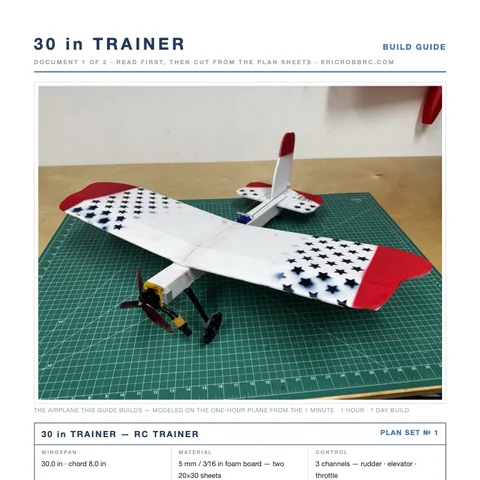 ER Sparrow Mk II Pre-Cut KitEvery foam part laser-cut and scored, the motor mount, the skewers, and the plans. Add your electronics and glue.$29.99See the kit →
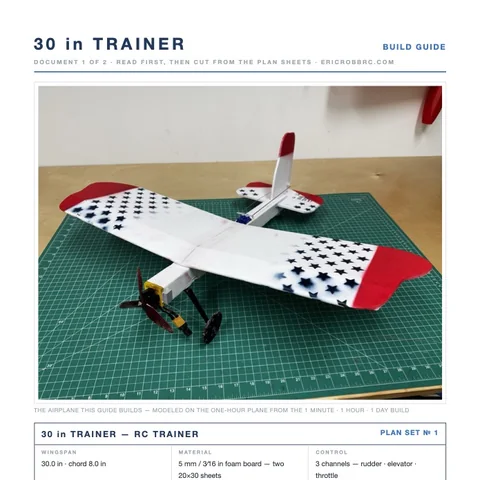 ER Sparrow Mk II PlansTrue-1:1 cutting templates and the 8-page build guide for the 30-inch one-hour trainer. Print at home or at a print shop.$8Get the plans →
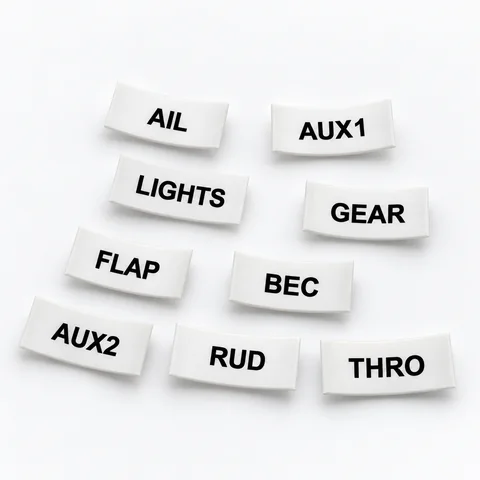 Servo Lead Heat-Shrink LabelsAIL, ELE, RUD, THRO and the rest, shrunk onto the lead so the receiver bay reads itself. Four packs.from $19.99See the label kit →
