Quick answers to the questions every builder asks: where does it balance, how long will it fly, how will it handle, how much current can my pack give, and how hard will it pull. All instant, all free. For a full design, use the Airplane Designer.
Put in your wing chord and get the balance point — how far behind the leading edge the plane should sit level on your fingertips, with the battery in.
How long a pack lasts at your average current draw, landing with a 20% reserve (never run a LiPo flat).
Weight per wing area is the best single indicator of how a plane handles and lands — not an exact stall-speed number, but the band you are in tells you a lot. Cubic wing loading (WCL) makes it comparable across sizes. Prefer to look it up? See the wing loading chart.
Big wing for the weight: slow, floaty, beginner-friendly.
Small wing, same weight: thrown hard, flown fast, lands fast.
Same plane, two wings. Wing loading is weight divided by wing area, and you can feel it — it sets how fast the plane has to move to stay in the air. Lower is easier: keep a first plane light.
How many amps your pack can actually deliver — and whether it covers your setup's full-throttle draw.
What to set the charger to for any pack — 1C means "capacity in amps" — the conservative setting when the pack's label gives no charge rate; when it does, the label wins.
Ballpark thrust from input watts and prop type, plus thrust-to-weight if you enter your plane's weight.
Most beginner crashes trace back to a number nobody checked. These quick calculators cover the ones that matter most on a scratch build — get them in range and the plane is forgiving; ignore them and no amount of stick skill saves it.
The single most important number. Measured as a percentage of the wing chord (the distance from the leading edge to the trailing edge), a typical first-flight CG for a conventional plane is around 25–30% of the mean aerodynamic chord back from the leading edge, with 27–28% a conservative start. Too far back (tail-heavy) makes a plane violently pitchy and usually un-flyable; slightly forward (nose-heavy) is safe and stable. Enter your chord and this gives you the exact spot to balance on two fingers.
Weight divided by wing area, usually in grams per square decimeter (g/dm²). It tells you how fast the plane has to move to stay in the air. Light wing loading (a park flyer around 30–50 g/dm²) means slow, floaty, beginner-friendly; high wing loading means fast and demanding. If your plane feels like it has to be thrown hard and flown fast, its wing loading is high.
The rest cover the power system: estimated flight time from battery capacity and average current, the maximum safe current your battery's C-rating allows, and static thrust versus weight (aim for at least a 1:2 thrust-to-weight ratio for a trainer, closer to 1:1 for something sporty).
Where should my CG be? Start around 27–28% of the chord (the typical band is 25–30% of the mean aerodynamic chord) and, if unsure, err slightly nose-heavy. What's a good wing loading for a first plane? Lower is easier — keep a trainer light. How do I use these numbers? Design the plane in the Airplane Designer, then use these to sanity-check it before you fly.
If a motor, prop or ESC is already in a drawer, the Parts Matcher takes what you own and works out what is missing — with the current draw and flight time behind it.
Open the Parts Matcher →Numbers dialed in. Turn them into a full design, or match a motor, ESC, battery and prop to your wingspan.
The airplane this site is built around, as plans or cut for you, and the small parts I use on every build.
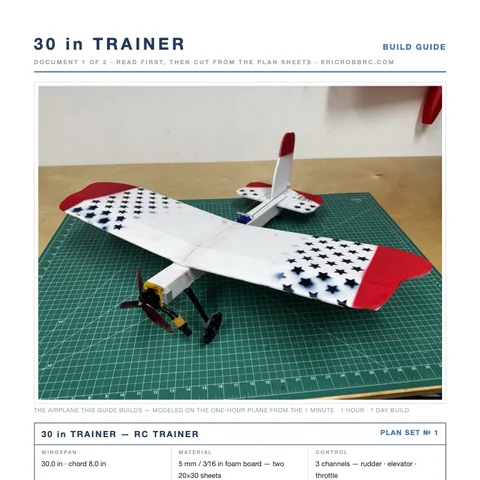 ER Sparrow Mk II Pre-Cut KitEvery foam part laser-cut and scored, the motor mount, the skewers, and the plans. Add your electronics and glue.$29.99See the kit →
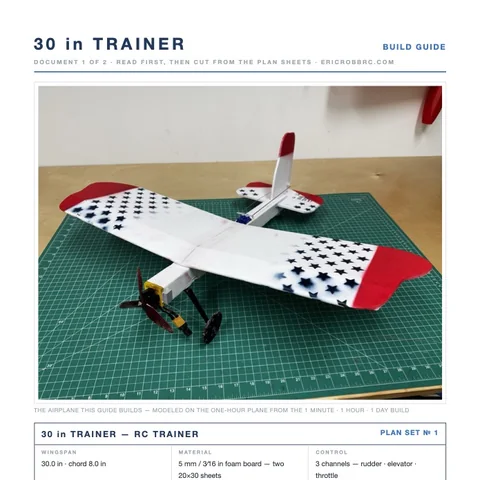 ER Sparrow Mk II PlansTrue-1:1 cutting templates and the 8-page build guide for the 30-inch one-hour trainer. Print at home or at a print shop.$8Get the plans →
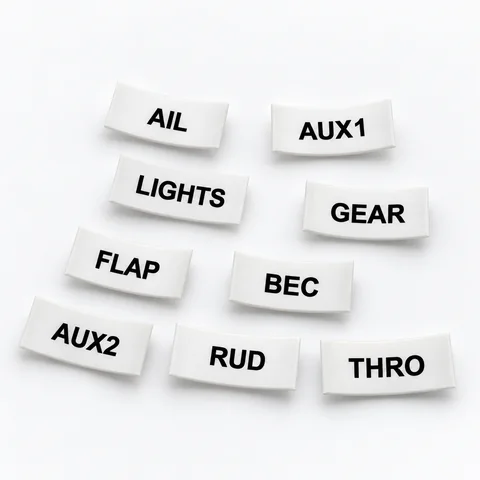 Servo Lead Heat-Shrink LabelsAIL, ELE, RUD, THRO and the rest, shrunk onto the lead so the receiver bay reads itself. Four packs.from $19.99See the label kit →
