A flat sheet of foam board flops. Bolt lift onto it and it folds. The spar is the part that decides whether your wing bends and springs back or bends and stays bent — and on this site there's a wing that came apart in the air to prove it. Here's what a spar does, the span where the Airplane Designer stops recommending bamboo and starts recommending carbon, and every spar material these builds actually run.
Last reviewed: August 2026
A spar is a tension/compression beam: the top and bottom surfaces carry the load. Paper-faced foam board is stiff enough on its own for small planes; past about 60 inches of span the wing needs a real spar such as a carbon rod, placed at 25–30% of chord over at least the middle two-thirds of the wing.
A spar is a tension/compression beam. When a wing lifts, it bends upward — which stretches one side of the spar and squeezes the other. That's the whole mechanism, and it's easiest to feel with a test piece in your hands: bend it one way and the top strip pulls taut; bend it the other way and the bottom does. The material at the top and bottom surfaces does all the heavy lifting, while whatever sits between them only has to hold those two surfaces a fixed distance apart so they can't buckle toward each other. Same principle as a steel I-beam or a real aircraft spar — nearly all the strength lives at the top and bottom, so the middle can be something almost weightless.
That's why the answer to a floppy wing is almost never "more foam." Foam added in the middle of the section adds weight where the load isn't. A thin rod at the right depth, or a folded channel with its two faces held apart, adds stiffness where the load is. It's also why the 20-foot cargo plane's spar is thin wood strips sandwiching a foam core rather than the "just use a 2×4" instinct: scale a solid beam across a big span and the weight becomes absurd. A spar has to be strong and light, or the wing folds under its own weight.
Paper-faced foam board hides this from you at small sizes, because its two paper skins already act a little like caps — which is exactly why a first 30-inch plane survives with almost nothing inside the wing. Take the paper away and the illusion goes with it: pink insulation foam (XPS) has no paper skin, so it gets its stiffness from your structure rather than the surface. That's the sentence that explains the whole 20-foot build.
Where the spar lives, looking down on the wing. The 25–30%-of-chord position is the one the wing-failure write-up calls for; the aileron station is the one the Airplane Designer plans to — in-wing at ~55% of each half-span, behind the spar.
Here's the honest version, taken straight out of the tool that sizes these planes: the Airplane Designer never designs a wing without a spar. Every parts list it generates carries a "Wing spar" line, at every span it will accept. Its weight estimate assumes one too — the airframe density it works from is described in the code as covering "foam skin, spar, glue and tape" as a single number. There is no span at which the tool says skip it.
What changes with size is the material, and there the tool draws one hard line: 60 inches of span. Below it, the spar's job is mostly to stop a crease from becoming a hinge, and cheap stock does that. Above it, the wing is carrying real bending load and the tool says so in plain words.
| Span | What the Airplane Designer does | In its own words |
|---|---|---|
| Up to 60″ | Lists Bamboo skewers (12in, 100-pack) as the wing-spar pick. | "Cheap spar + reinforcement stock for this size." |
| Past 60″ | Switches the wing-spar pick to Carbon fiber rod (3mm, wing spars). | "Past 60″ the wing needs real spar stiffness — foam alone folds." |
| Past 70″ | Adds a "big build" warning to the whole design. | Spar strength, wing attachment and control loads "deserve real attention — plan on stronger structure than plain foam board." |
| Past 120″ | Stops pretending it can size the structure at all. | Structural loads, spar design, flutter and inertia "can NOT be safely predicted from simple scaling rules." It points at the 20-foot build, which needed laser-cut ribs, an aluminum box spar, and load testing. |
| Past 150″ | Tells you to prototype and test before cutting. | Size the spar "for the whole flying weight with margin," prototype the wing structure smaller and load-test it first. If the chord comes out wider than a 48″ foam sheet, the wing gets joined from panels — "put a spar behind each one." |
Read those bands as one continuous idea rather than five rules: as span goes up, the wing's bending load grows faster than the foam's ability to carry it, so the spar takes over more and more of the job — from "insurance against a crease" at trainer sizes, to the structure at giant scale, where the 20-footer's spar was flex-tested by hand before anything got committed.
Five options, roughly in order of span. The first two are the ones the Designer picks for you and both live in the foam & materials section of the gear guide; the last three you build yourself out of what's already on the bench.
"The cheapest wing spar and reinforcement stock there is — I use these constantly." Good for spars, joints and pushrod stock, which is why a 100-pack outlives several airplanes.
This is the Designer's pick for anything at or under 60″: cheap spar plus reinforcement stock for that size. Buried in a wing at 25–30% of chord, a skewer's job is to stop a hard landing's crease from turning into a fold line.
The gear guide's one-line description says the whole thing: "Stiffens wings so they don't fold in flight." Good for stiffening wings on any foamie.
The spec that matters, from the plane that lost a wing: a 3mm rod set at 25–30% of chord — full span, or at least the middle two-thirds. It costs a few dollars and transforms a foam wing.
The tube fold stopped at three faces: a U-shaped beam instead of a closed tube. Two channels inside the middle face let both sides fold up square.
C-channels are the classic foam-board wing spar — most of a tube's stiffness at even less weight, and the material is the board you already bought.
The 20-footer's answer: split the board down the middle, cut strips, and sandwich foam in between. It sounds too simple to work. It isn't — the thin wood strips are the caps that carry the load, and the foam core's only job is to hold them apart.
Verdict after building one and flexing it by hand: "Yeah, that's actually pretty solid. I'm impressed." The full spar test is here.
On the 20-foot wing, the panels join through a box spar — layers of wood forming a box that captures a removable aluminum tube set at an angle, which is what gives the wing its dihedral.
Treat it as the part where failure is catastrophic, because it is. It also produced the scariest moment of that build week: expanding glue in the box very nearly locked the removable joiner tube in permanently.
The C-channel is the one spar you can make with nothing but the board, a straightedge and a knife — and it's the same technique as every fuselage on this site, just stopped one face early. The full method, with an interactive marking calculator, is on the foam board tube folds guide; set its tube type to "C-channel (3 faces) — spar", enter the face size you want, and it prints every ruler mark in order.
The rule that makes it work is the channel. Foam board is ≈3/16″ thick, and a plain fold has to bend around that thickness: the paper cracks, the corner rounds over, and the beam comes out sloppy and wider than you marked. So you take the foam out of the corner's way — cut a 3/16″-wide strip where you remove the near paper and the foam, and leave the far paper untouched. That surviving paper is the hinge; the neighbouring face nests into the empty channel; the corner closes dead square.
Then glue the finished channel into the wing at 25–30% of chord with its open side facing whichever way the wing skin lets you close it out. The beam is doing the same job as a carbon rod, just with its caps further apart — the top and bottom faces of the C are the caps, and the web between them is what holds those faces at a fixed distance.
Most spar advice online is theory. This one isn't: the Crackle Cub passed its control check and its CG check, went up, and dropped half a wing in flight. Two things came out of it that change how you build a spar.
First — the spar joint fails, not the spar. The carbon rod or skewer almost never snaps. What lets go is the glue joint holding it to the foam, usually after a hard landing weakened it invisibly. So the money you spend on a stiffer rod is wasted if the rod is only tacked in: bed it along its whole length, not in three spots, and treat any wing that's had a hard arrival as suspect even when it looks fine. Foam hides damage — a wing that took a hit and "looked fine" can be creased inside the paper skin, and a crease is a hinge waiting for its moment.
Second — a failing wing doesn't announce itself as a wing problem. In the air it felt tail-heavy: lose outboard wing area and you lose lift, the lift you still have acts closer to the fuselage, the plane mushes and the controls go soft. If a plane suddenly flies tail-heavy mid-flight when it balanced fine on the ground, suspect the airframe before the battery position.
The other two ways foam wings shed parts are worth knowing while you're gluing: hot glue joints soften noticeably in a parked car in summer, so a plane that bakes on the way to the field arrives with weaker joints than it left with; and at higher speeds a loose surface or floppy wing skin can flutter and shed parts in seconds — if you ever hear a sudden buzz, throttle back immediately.
For what it's worth, the airframe was fixable — foam board forgives everything — but that one still knocked the wind out of me, and the plane sat on the shelf for five months before it flew again. Building the spar in properly is cheaper than the five months.
One adhesive decision quietly killed a 10-foot plane before the 20-foot build started — the glue grabbed the foam's plastic film instead of the foam itself, and the wings came apart overnight. The transferable lesson, and it takes five minutes: glue two scraps of your actual material, let them cure fully, then try to tear them apart. Two scraps will tell you more than any product label, and it's the exact test that would have saved that airplane. It matters double if you've moved off paper-faced board — XPS is chemically fussier, and solvent-based adhesives and some spray paints will eat it, so everything touching it has to be foam-safe.
Plan on one. The Designer lists a wing spar for every span it will design, and at trainer sizes that's a bamboo skewer — pennies, and the difference between a crease and a fold line.
Bamboo up to 60″ of span, 3mm carbon past it. That's the exact line the Airplane Designer draws, and the reason it gives is that past 60″ foam alone folds.
Full span if you can, and at least the middle two-thirds if you can't — that's where the bending load is highest and where the wing that failed needed it.
What these builds show is one spanwise spar at 25–30% of chord on the foam-board planes, and a box spar carrying the joint on the giant. If you're joining panels because your chord is wider than a 48″ sheet, the rule from the tool is to put a spar behind each seam.
Enter your wingspan in the Airplane Designer and it returns the whole parts list — including which spar material your size lands on — alongside the weight, power and balance numbers.
The airplane this site is built around, as plans or cut for you, and the small parts I use on every build.
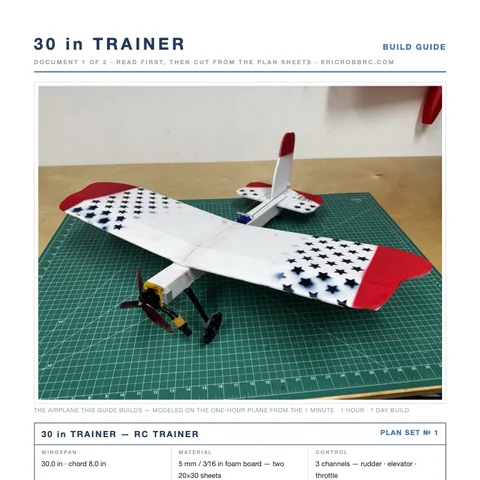 ER Sparrow Mk II Pre-Cut KitEvery foam part laser-cut and scored, the motor mount, the skewers, and the plans. Add your electronics and glue.$29.99See the kit →
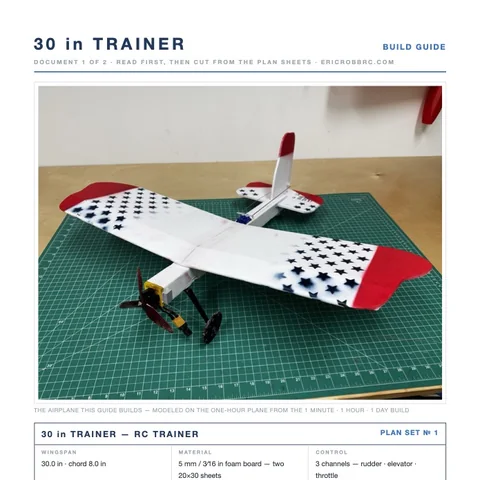 ER Sparrow Mk II PlansTrue-1:1 cutting templates and the 8-page build guide for the 30-inch one-hour trainer. Print at home or at a print shop.$8Get the plans →
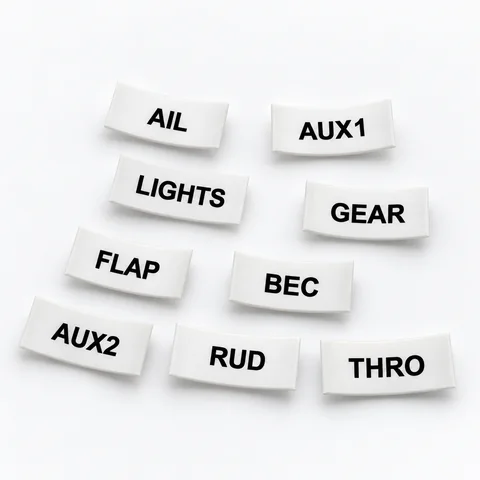 Servo Lead Heat-Shrink LabelsAIL, ELE, RUD, THRO and the rest, shrunk onto the lead so the receiver bay reads itself. Four packs.from $19.99See the label kit →
