This plane sat on the shelf for five months. It flew badly, then it broke a wing in the air, and I was genuinely ready to write off the whole idea of a 3D-printed airplane. Instead I gave it one more weekend — and the three fixes that finally made it fly are the same three that trip up almost everyone printing their own wings.
| Change | Why it mattered |
|---|---|
| Carbon-fiber spar | The printed wing had no real backbone. A carbon tube through the wing stops the flex that led to the failure. |
| CG at ~15% chord | It was flying tail-heavy and twitchy. Moving the balance point forward made it settle down and track. |
| Fly it faster | A dense printed plane needs more airspeed and power than a foamie. Held on ~70% throttle, it flew; babied at low speed, it fell out of the air. |
| Give it altitude | Every problem is fixable with height. Trim and sort it out three mistakes high, not off the deck. |
This is the "Crackle Cub," a 3D-printed take on a Cub-style plane, and it and I have history. Earlier this year the wing failed mid-flight — it folded and the plane came down. I pulled that failure apart in its own write-up (what broke, and why a printed wing folds where it does): the Crackle Cub wing-failure teardown. This project picks up on the other side of that crash — after five months of the plane sitting on the shelf while I decided whether a 3D-printed airplane was even worth the trouble.
The original wing relied on printed plastic to carry the whole bending load, and plastic printed in thin wing skins simply isn't stiff enough over a long span. The fix was a carbon-fiber spar running through the wing — a stiff backbone that takes the bending load the plastic couldn't. This is the single biggest lesson of printed airplanes: print the shape, but let carbon carry the load. The plastic is there to make an airfoil and hold the skin; the spar is what keeps the wing from folding when you pull g's or hit a gust.
A carbon spar through the printed wing is what turned five months on a shelf into a flying airplane — the plastic makes the airfoil shape and holds the skin; the carbon carries the bending load the plastic couldn't.
The spec that matters: a continuous rod running through the wing — a stiff backbone, not short segments. Print the shape, let carbon carry the load.
Skip the spar and the thin printed skins carry the whole bending load — that's exactly the flex that folded this wing mid-flight.
It had been flying tail-heavy, which on any airplane feels like a plane that won't settle — pitchy, over-sensitive on the elevator, wanting to balloon and stall. I moved the balance point forward to roughly 15% of the wing chord back from the leading edge, a safe, slightly nose-forward starting point. A nose-heavy plane flies boring and safe; a tail-heavy plane flies exciting right up until it doesn't. On a maiden you always want boring. If you're not sure where yours should balance, the Airplane Designer and the CG calculator put the number on your specific wing.
A 3D-printed plane is heavier and denser than the foam board most of us learn on, and that changes how you have to fly it. More weight for the same wing means a higher stall speed — it needs more airspeed to keep flying and more power to hold that speed. The instinct after a bad flight is to baby it, fly slow and gentle. That's exactly backwards. Once I committed to keeping the power up around 70% throttle and let it fly at a proper speed, it flew like an airplane instead of mushing along on the edge of a stall.
The last thing that changed was patience. I launched it, climbed out, and did all the trimming and sorting-out up high, where a mistake costs a few seconds of altitude instead of the airplane. "Three mistakes high" is the old saying and it's true: give yourself the height to react, get the trims dialed, then bring it down to have fun. Low-and-slow over the field is where good planes go to die.
Fair question — foam is cheaper, lighter and more forgiving. But a printer lets you make compound shapes foam can't — real cowls, scale fuselages, curved wingtips — and iterate a design overnight. The trade is that you're now the structural engineer: you have to add back the stiffness the plastic doesn't have, watch your weight, and fly with the extra speed the density demands. Get those three things right and a printed plane is a genuinely rewarding build. Get them wrong and you get five months on a shelf and a folded wing.
If you want to go down this road, the 3D printing gear section covers the printer and filament I use for airplane parts, and the belt-printer conversion is how I print wing panels longer than the bed. When it's time to fly, the Flight Doctor will talk you through anything that misbehaves on the maiden.
Nothing to correct yet — this write-up matches the video, and the three fixes (spar, forward CG, speed) are holding. Spot something off? Tell me and I'll fix it.
Auto-transcribed from the video, so expect the odd mis-heard word. Here so you can search or skim what was said without watching.
Please don't crash again. Oh my gosh. And this was the moment I almost gave up on 3D printed R3 airplanes for good. I have built this plane once before in another video and it didn't fly great, but for some reason I couldn't let this plane beat me. So I built it again and when that version crashed I was devastated.
So eventually I put it away for like five months until I finally came back and figured out what I was doing wrong. So this is the Cracol Cup, a 3D printed R3 airplane. I had already tried one of these before on my channel and it was one of those projects that kind of worked but not really. It looked like a plane that looks really cool. It was really easy to put together.
It technically made it into the air but it never actually flew well. And that bothered me. So when I decided to build it again the goal was simple. Get the thing built, clean, get the electronics in and finally prove that this 3D printed airplane could actually fly right. At least that was the plan.
This is actually a really well designed airplane which makes it assemble so easily. You can see the channels here for the push rods. Super clean. So most of this is just gluing parts together, fishing wires through, installing the electronics and watching it slowly turn into something that looks like a real airplane. All the parts on this plane have alignment tabs so it makes it super easy to snap in all the parts and glue them together.
Now that we've got both the tabs of the wing done we can then start beginning to glue them onto the fuselage. Once we fish our wire through here we can add a little bit of glue and glue our wing halves on. As you can see they're a little bit floppy but that's not too bad. We just add our wing struts and it makes it fairly strong in very light weight. Now we get our motor mount connected to our motor here.
A couple of screws, fish our ESC through the fuselage and push our motor in. And then we can use some screws to secure it into place. At this point I was feeling pretty good about the plane. The plane looked awesome, the controls were working and I really thought this was going to be the flight where the design finally redeemed itself. Just like that the Cracall Cub is already in done and it's looking awesome out here.
So let's take it up and fly it a little bit. See how it goes. I'm going to make sure that our center of gravity is correct so let's check that here. Which I think it's looking pretty perfect. How does it feel so tail heavy?
No! Look at that you've got to be kidding me. Missing half of a wing. Good thing we just reprint it and build it again. Moraciously somehow I got the plane all glued back together and it's in one piece.
So we're going to try to fly it again and hopefully we don't crash into a tree this time. You've got to be kidding me. What are you doing? Please don't crash again. Oh my gosh this plane is so stupid.
You deserve to be crashed. Alrighty this has happened too many times. Had enough of this. What if we could reinforce this somehow? What if we could add something to make it sturdier?
Oh what about this? Carbon fiber rod? Hey that could be perfect. Let's build a new one with carbon fiber in it and hopefully it'll be sturdier and stronger and hopefully we won't have this ever again. Okay so basically on this new version what we've got going here is we've got this carbon fiber rod it's five millimeters so it goes through these indexes here and then it goes into the wing.
See there's little channels for it to go into and that will help strengthen the wing right there. Help keep it straight and strong and that's what we want. You've already seen me build this one so let me just clap or clap or through it and so we are back out here we printed the new one they've updated the design and it made it really really easy to go together. So I put a faster motor in this thing because I was told that the plane likes to fly fast and it doesn't have enough acceleration and won't be able to get enough lift. It's actually fly well so That's ridiculous.
Okay hopefully there's something fly. Please fly so we'll see how well it works. Gosh well that's about what I expected not good. Okay well we'll see if we can get this thing back together and try again. So I guess the carbon fiber spar didn't magically fix everything and at some point you just kind of have to give up.
Or do you? So five months later now I decided to give this thing another try. Since I crashed it in the last flip I replaced some of the parts on it that were broken. It's just really convenient about three different planes that you can just print new sections and kind of cut it apart and add in the section you need. But anyways let's get to the footage of actually flying this plane.
This is amazing. Go watch it. Okay so I got this Crickle Cub all here all finished up ready to go. We're going to put this thing to the test. I got the center of gravity set to where I want it about 15% back on the wing.
Control services are all looking good so I think we're going to just send it. I just got to give it a little bit more thrust than I'm used to. I'm used to flying foamies and they don't really take a lot of power to take off. I think these things just take a little bit more power than I'm used to. So I'm just going to send it and hopefully it works fine.
We'll see. Please subscribe. I need your luck. We're going to give it 70% throttle and we're going to chuck it. See how it does.
Oh my gosh it's flying. It's flying. Oh sorry your camera footage looks terrible. Yeah look at that go. So exciting.
This is amazing. It's actually flying pretty good. Yeah I think these 30-pram planes just take a little bit more thrust than I'm expecting that they're going to need. I don't know why I've had so much problems in the past. I think I'm just underpowering the plane.
It needs a big motor and it needs to fly fast. Because they're just a little bit heavier than the... I get a lot of forgiveness with foam. I like to look at that go. Look at that go.
Here let's try a roll here. Nope. Look at that go. I love it. This thing's got a carbon fiber spar so it's going to be plenty strong for any kind of thing we throw at it.
Okay I haven't even thought about trimming this thing out yet. It flies great. Look at it go. My god. Look at that.
Whoa. Look at that. Whoa. Well that'll do it for you. So I think the plane just stalled.
I don't know what happened there. I switched the elevator a little bit and it just went nose-diving into the ground. That's why you fly three mistakes high guys. So let's go see what the damage is because that was a pretty hard hit. So hopefully it's not too bad because I kind of want this plane to fly because it's so much fun.
Okay okay okay. Look the wing is mostly intact. This piece here is actually in perfect condition. This piece needs to be reprinted. But honestly maybe I could reprint this section here.
Reprint these two slide pieces and then we'll get this thing back in here. Honestly I love 3D printing and I love RC planes. This is a fantastic combination. I'm so excited that I got this plane to actually fly. So I appreciate you guys so much for watching and sticking with me through this.
And I'm trying to get to 10,000 subscribers. I got 10,000 subscribers. I'm trying to get to 100,000 subscribers at some point. Hopefully by the end of the year. So if you want to support me and my channel click that subscribe button and I appreciate it.
If you want to fly and build one of these planes for yourself go check the link out in my description. It's the Cracol Cub and you can get the files and download it for yourself and print it out. Any of you print one leave me a comment and tell me that you made one. I'd be so excited to hear how yours flies and I will see you guys in the next one. Adios!
The airplane this site is built around, as plans or cut for you, and the small parts I use on every build.
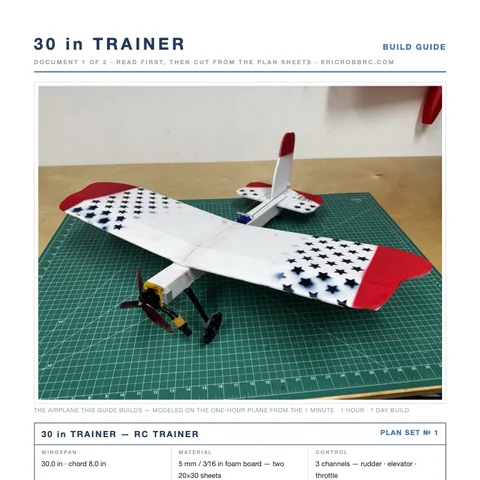 ER Sparrow Mk II Pre-Cut KitEvery foam part laser-cut and scored, the motor mount, the skewers, and the plans. Add your electronics and glue.$29.99See the kit →
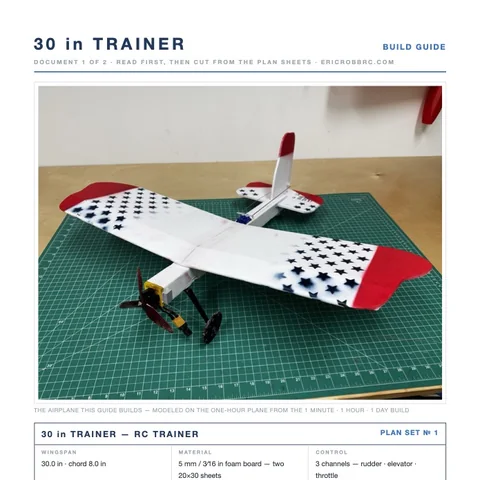 ER Sparrow Mk II PlansTrue-1:1 cutting templates and the 8-page build guide for the 30-inch one-hour trainer. Print at home or at a print shop.$8Get the plans →
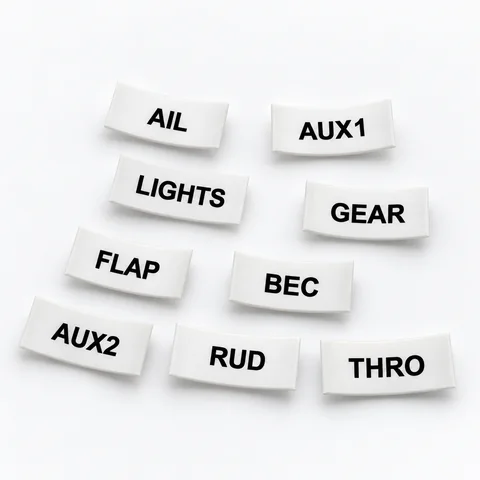 Servo Lead Heat-Shrink LabelsAIL, ELE, RUD, THRO and the rest, shrunk onto the lead so the receiver bay reads itself. Four packs.from $19.99See the label kit →
