Five parts make almost every RC plane fly: a battery, an ESC, a motor, a receiver, and servos. Once you understand what each one does and how they connect, the rest of the hobby stops feeling like alphabet soup.
Last reviewed: August 2026
Five parts make an RC plane fly: the battery powers the ESC, the ESC drives the motor and feeds 5V to the receiver through its BEC, the transmitter talks to the receiver by radio, and the receiver moves the servos. Every part has to match the others in voltage, current, and connector.
Reading how the parts connect is one thing; seeing your setup drawn out is another. My free RC Wiring Designer takes your battery, ESC, receiver, and servos and draws a color-coded wiring diagram for that exact combination — plus the right hookup order and the mistakes that fry electronics.
Open the Wiring Designer →
Almost all electric RC planes run on a LiPo (lithium-polymer) battery. It stores the energy that powers everything. You'll see specs like 3S 1500mAh 30C — here's what that means:
LiPos need care and respect — see the full Battery & LiPo Basics guide. And when it's time to actually buy one, choosing a LiPo pack for your plane matches those three numbers to your wingspan and to what your ESC and motor are rated for.
The ESC (Electronic Speed Controller) sits between the battery and the motor. It takes the throttle signal from your receiver and feeds the motor exactly the right amount of power — from idle to full send.
ESCs are rated in amps (e.g. "30A"). The rating must be equal to or higher than the maximum current your motor will pull, or the ESC overheats and dies. When in doubt, size up. Not sure what your motor pulls? The RC Calculators include a C-rating / max-current check.
Follow the thick wire for the muscle: battery → ESC → motor, with the ESC metering the flow from idle to full send. The thin green line is the ESC's BEC sending 5V back to the receiver and servos — that's why the radio gear usually doesn't need its own battery.
The motor spins the propeller to make thrust. Most modern planes use brushless motors — efficient, powerful, and long-lasting. The key spec is Kv:
The motor, prop, and battery have to be matched. Most beginner kits and "power packs" sell these pre-matched so you don't have to do the math — or let the Airplane Designer pick a matched setup for your wingspan. If you'd rather understand the reasoning than trust a bundle, matching a motor, ESC, battery and prop works down from wingspan to Kv, amps, cell count, and prop size.
The receiver (RX) lives in the plane and listens to your transmitter (TX) — the handheld controller. They get linked once in a one-time pairing step called binding. After that, every stick movement you make is sent to the receiver, which passes it on to the ESC and servos.
The number of channels a receiver has = how many things it can control. A basic 4-channel plane needs throttle, elevator, ailerons, and rudder — see the first-plane guide for what those do.
A servo is a small motor that moves to a precise position and holds it. Each control surface (the moving flaps on the wings and tail) is pushed and pulled by a servo via a thin metal rod. When you move a stick, the receiver tells the matching servo where to go.
Servos are sized by weight and torque — small "9g" servos are the common beginner standard for light foam planes. More torque is needed for bigger, faster planes with more air pushing on the surfaces.
That's all five parts described in general. To get them picked for one specific airplane instead, the electronics checklist builder asks a few questions about your build and hands back a matched motor, ESC, prop, battery, servo and radio list you can tick off as you buy.
Follow the power and the signal and the whole system makes sense — or see the whole airplane drawn out at once on the labeled RC airplane wiring diagram, which is these same four connections plus the hookup order:
Those same five parts, connected on the bench — motor, ESC, battery, receiver, and servos. The full write-up is here: RC Plane Connections Simplified: Motor, ESC, Receiver, Battery. One thing that trips people up before they get that far: RC never settled on a single battery plug, so if the connector on your pack doesn't match your ESC or charger, start by identifying the plug by shape and color.
This matters the moment you connect power. Treat an electric RC airplane as live whenever the battery is connected — the motor can start instantly from a bumped throttle stick, a radio setting, a receiver failsafe, a wiring fault, or an accidental command. Remove the propeller while you configure the receiver, calibrate the ESC, test control directions, or troubleshoot the power system — any time the prop isn't actually needed for the test.
At the field:
Wear safety glasses — and remember they protect your eyes, not your hands: stay out of the propeller arc.
Small parts from my own bench that make the wiring side of a build cleaner.
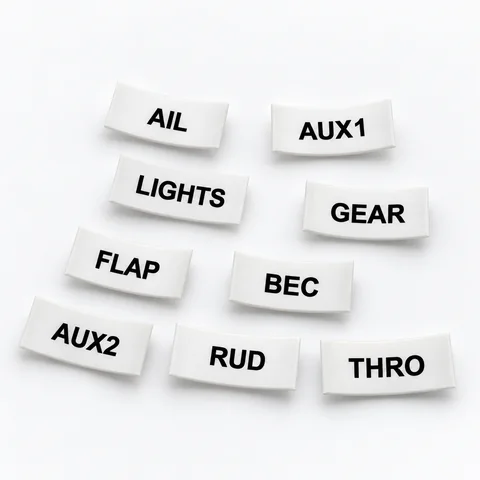 Servo Lead Heat-Shrink LabelsAIL, ELE, RUD, THRO and the rest, shrunk onto the lead so the receiver bay reads itself. Four packs.from $19.99See the label kit →
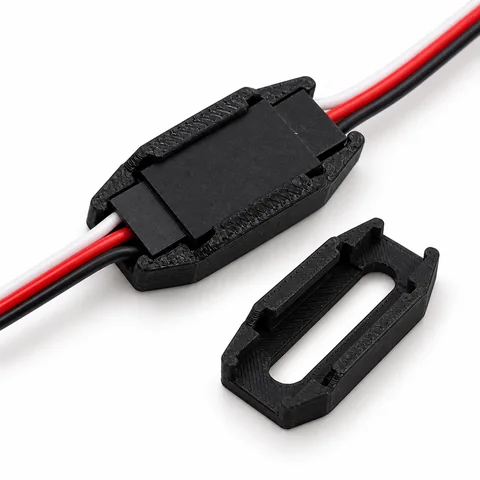 Servo Connector Safety LocksFifty locks that fit around a joined servo connection so an extension out in a wing stays plugged in.$14.99See the locks →
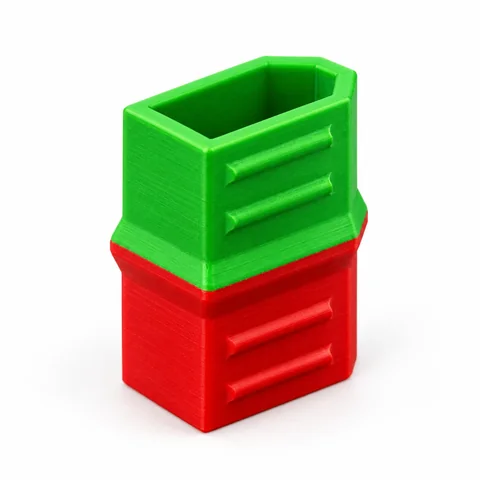 XT60 Battery Status CapsGreen end out: charged and ready. Red end out: flown. Twelve caps, so every pack in the box tells you.$11.99See the caps →
