Years ago I got curious about how solid rocket motors work and made some homemade ones. The video's still up, and I'm not going to pretend it isn't — but this write-up is deliberately not a how-to. It's the honest version: what the experiment actually was, why it's more dangerous and more regulated than it looks on YouTube, and the genuinely better way to get into rocketry that I wish I'd started with.
This page intentionally leaves out formulas, ratios, and construction steps. Homemade propellant is an energetic material: mixing, pressing, or confining it can burn, explode, or detonate and has cost hobbyists fingers, eyes, and lives. In much of the U.S. and elsewhere, manufacturing rocket propellant or motors without the proper licensing is also illegal. If rocketry excites you, do it the certified way described at the bottom of this page — it flies higher, works reliably every launch, and won’t send you to the ER or to court.
This falls under what hobbyists call amateur experimental rocketry — specifically the "sugar motor" family, where a common sugar is combined with an oxidizer to make a solid propellant. It's popular in YouTube videos because the ingredients sound innocent and the idea is old and well documented. I was curious how the whole thing worked end to end — propellant, casing, nozzle, ignition — so I built a few and tested them. I'm keeping this description at the concept level on purpose; the point here isn't to hand anyone a recipe.
Here's the part the exciting thumbnails skip: my homemade motors made far less thrust than I'd hoped. Amateur propellant is fussy — how it's prepared, how densely it's packed, the nozzle throat, tiny voids and moisture — and small mistakes turn "rocket" into "smoke bomb that fizzles" or, much worse, "casing that lets go all at once." The gap between a video that looks cool and a motor that actually performs safely is enormous, and it's filled with exactly the details I'm not putting on this page. I got a lot of learning and not much altitude.
Homemade propellant is an energetic material, and the failure modes are severe:
People with far more experience than me have lost fingers and eyes to this. That's not a scare tactic; it's the base rate.
Making your own rocket motors or propellant is regulated. In the United States, manufacturing propellant or motors generally falls under federal explosives law (ATF), storage rules, and a patchwork of state and local ordinances — and "I only made a small one" is not the exemption people assume it is. Certified commercial motors and the model-rocketry safety code are how the hobby stays legal and insurable. Building your own outside that framework can put you on the wrong side of the law before you ever light it.
None of this means "don't do rocketry." It means do the version that's designed to be safe, legal, and repeatable — and it's genuinely more fun because your rockets actually fly:
If it's the building that pulls at you more than the propellant, that instinct is exactly what this whole site is about — just aimed at aircraft. The homemade body-tubes build is a safe, satisfying fabrication project (and those tubes double as airplane tail booms), and the Airplane Designer and project archive are full of things that fly without any of the risk on this page.
Auto-transcribed from the video, so expect the odd mis-heard word. Here so you can search or skim what was said without watching.
Hey guys and welcome back to my channel. In today's video we are going to be making solid rock vitamins using sugar. This is a very simple process using three simple ingredients. Powdered sugar, canner 3U or potassium nitrate, which you can find very readily available in Stumpford Moeller, which you can find at your local Lowe's or home improvement store. You also need kitty litter that we're going to use for the ends to cap them off and to form our nozzle.
So we're going to start off with our kitty litter here. So we're just going to put it in a blender, just a cheap little blender that it doesn't have to be very strong. So we're just going to put it in there and grind this kitty litter up as fine as we can. Okay, so for this we're going to move on to our Stumpford Mover. So here's the bottle.
I just got it at Lowe's. So we are just going to grind this up so it's a little bit finer. Then we can mix it with our powdered sugar. So this is going to be at a ratio of 65 grams of potassium nitrate to 35 grams of sugar. So we're going to add 65 grams.
Okay, so now that that's mixed up pretty fine, we can add it back to our container. Now we're going to mix in our 35 grams of powdered sugar. And we're going to blend that up as well. Okay, now that that's all good, we can mix them together. So the reason that we ground them up separate is because once they're mixed together, they become more hazardous and they can combust.
So we just want to make sure that we're not putting that through a metal grinder at such high speeds. And I don't know, something could happen. It's just a safety thing. So let's just shake this up for about two or three minutes until it's nice and evenly shirking up. And then we're going to go and start packing.
So now that that's hopefully all mixed up and we are all good with that, we just want to make sure that we get a nice good blend because if it's any consistency at all, we don't want to have anything have a problem. It is rocket science after all. Now that we have this all mixed up and ready to go, we can start packing a rocket. Okay, so we're ready to pack a rocket. So we have a tube of schedule 40 PVC, three quarter inch.
And this is an interdiameter, three quarter inch. That's what it's standard in US. And it is also five inches in length. So and we also have a wooden dowel here with some markings on there. And these measurements are as follows on screen.
Okay, so how the stick is going to work is we are going to put some, for example, our first layers clay. So we're going to put our stick in there and we're going to fill it up until you see the top layer sticking out like that. So let's do it. So I'm just holding it firmly against the table. And I'm just pouring a little bit and measure and see a check it.
And you really want to pack as you go. Do you want to get this packed down as firm as you can? So this right here is rocket fuel. So if you let this right now, it would go up in flames and it would not end well for me. Okay, so it looks like a little bit past the mark, but that's okay.
And we are going to move on to the next step. So that's going to add the clay on the top. So it's just going to cap it off and let's do that now. Okay, and that looks great. So now we just got to draw out the core so that we can put our fuse in there and it will ignite.
Okay, so I have a long three sixteenths inch bit right here and we are going to drill down into it with a. So we are going to drill down into this about three and a half inches. I have a mark right here. You can also put a piece of tape there if you want. And we are just going to see if we can do it by hand, but we might have to get the drill out.
So we are just going to keep it centered. Okay, so that worked out very well and it looks great. So I got down far enough and I think it's fine. You just want to make sure that you are not overheating that when you are drilling it out because it is rocket fuel and it could ignite. So just be careful with that.
If you are concerned about it doing a safe environment, you could easily throw it out the window or something like that. If something crazy would happen. So just be safe. Let's get out there and test this engine. If you like this video, please consider subscribing to my channel.
You can check out more of my videos as they come out regularly. Let's go test this motor. Okay guys, so I have an older one that I made a while back. I am going to test to see all the compares to the one we just made. See if they go bad.
I live alone with you inside my mind. We would dance the night away to the morning light. Can I give you all my love? Till we dance the night away. Can I give you all my love?
Till we dance the night away. And we give you all my love. Okay guys, so after reviewing the footage, it doesn't look like I have produced a whole lot of thrusts. But that's okay because my system probably wasn't set up very well. I could do a better job in the future.
If you guys are interested in this stuff, please like and subscribe and leave me a comment where you like most about this video. Bye! Music playing.
Everything else on this site is free; these are what pay for it.
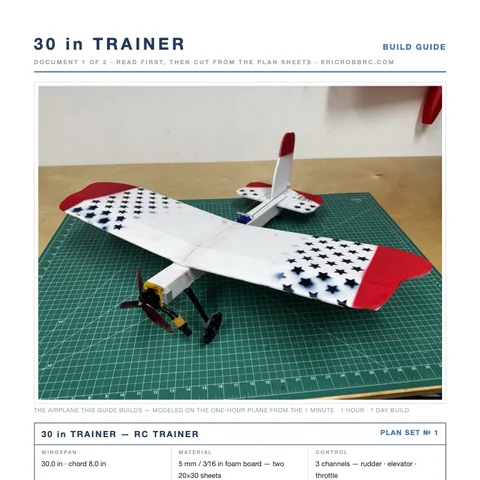 ER Sparrow Mk II Pre-Cut KitEvery foam part laser-cut and scored, the motor mount, the skewers, and the plans. Add your electronics and glue.$29.99See the kit →
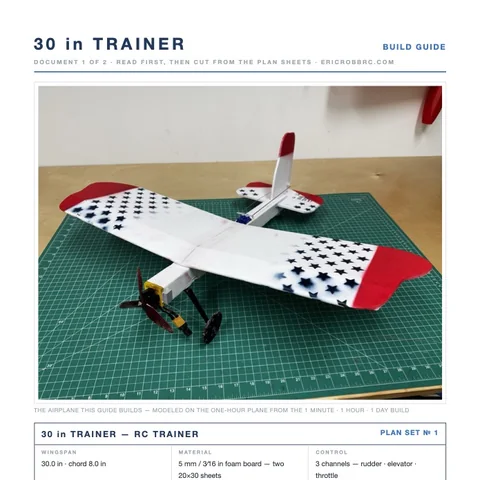 ER Sparrow Mk II PlansTrue-1:1 cutting templates and the 8-page build guide for the 30-inch one-hour trainer. Print at home or at a print shop.$8Get the plans →
 Servo Lead Heat-Shrink LabelsAIL, ELE, RUD, THRO and the rest, shrunk onto the lead so the receiver bay reads itself. Four packs.from $19.99See the label kit →
