Hardware store foam, glue that wouldn't stick, motors we hoped were powerful enough, three days of work in a storm — and a golf-cart launch in front of thousands. This is the story of Big Red, why it failed, and exactly what changes before this year's 20-foot cargo plane.
| Problem | What happened | The fix for the 20-footer |
|---|---|---|
| No real design | 10-ft wing, big fuselage, a mock-up — and everything else decided while building | Design complete before the first cut |
| Glue vs. coated foam | The foam's plastic film let go overnight; wings pulled apart | Every material and joint tested first |
| Unknown weight | No weight plan → no power plan → full throttle and it barely moved | Weight budget and thrust math up front |
Flite Fest is — as Preston puts it — a giant demolition derby in the sky. A storm shut down flying on day one, everyone bailed to a nearby airfield, and that's where I met Preston Goes. He'd flown a plane exactly once. His dream first scratch build? A massive combat plane. Somehow I became the guy making that happen.
Next thing I know I'm at Home Depot with a couple of strangers buying foam, wood, and anything that looked like it could become an airplane, and we're converting an RV into a workshop while the storm rages outside. Chaotic, rushed, and honestly one of the most fun projects I've ever been part of.
We knew the plane needed a 10-foot wing, a large fuselage, and room for a giant net. That was… basically the whole plan. Structure, electronics, weight, balance — all decided mid-build.
Here's the thing about that: winging it genuinely works on a small foam board plane, because at that size mistakes are light and cheap. At a 10-foot span, every brace adds real weight, every change moves the balance point, and every extra pound demands more from motors you've already bought. We were creating problems faster than we could solve them.
This is exactly why I tell everyone to run their numbers before cutting foam — it's the whole reason the Airplane Designer exists. Thirty seconds of wingspan-and-style input gets you a weight estimate, a balance point, and a power plan. On a giant, skipping that step isn't a shortcut; it's the long way around.
The hardware store foam had a thin plastic coating. Our glue looked fine going on — and the next morning the wings were pulling themselves apart. Hours of work, undone overnight.
We peeled sections apart, tried different adhesives, stripped some of the coating, roughed up surfaces, and rebuilt. It cost us huge time, added weight, and worst of all: we never fully trusted the structure again.
The general rule: insulation foams and coated boards are not paper-faced foam board — hot glue and regular CA often grip the film, not the foam. Glue two scraps, let them cure overnight, and try to rip them apart before you commit a wing to it. (For standard foam board, the adhesives on my gear page are the proven combo.)
Big Red died by adhesive — the glue gripped the foam's plastic coating instead of the foam, and the wings pulled themselves apart overnight. For standard paper-faced foam board, this foam-safe CA is part of the proven combo on my gear page.
The spec that matters: foam-safe, so it bites the foam itself. On coated boards, ordinary hot glue and CA often grip the film, not the structure.
Switching materials? Insulation foams and coated boards are not paper-faced foam board — glue two scraps, let them cure overnight, and try to rip them apart before you commit a wing to it.
Because we never knew what the finished plane would weigh, we couldn't size motors, props, or batteries — we bought what was available at the event and hoped. Full throttle on the runway: it barely moved.
We stripped drag, swapped packs, and eventually jumped from 3S to 6S — real power at last, but by then we'd missed our combat slot, and the plane still struggled to lift off. Was it also a balance problem? Honestly, we still don't know.
The math that would have saved us: a big, slow hauler wants roughly 100+ watts per pound and about 0.7:1 thrust-to-weight. Know the weight, and the motor, prop, and battery choices fall out automatically — that's the calculator math, and it works at 2 feet or 20.
Final day, one last chance, and a suggestion: launch it off the roof of a moving golf cart. We couldn't test it first — didn't know how fast to drive, how the plane would leave the platform, or how much control we'd have. Our first full-system test was the launch itself, in front of the whole crowd.
The cart accelerated. Big Red left the platform. And dropped straight to the ground. "Yeah, that's what you call a failure."
This year Preston and I are building a 20-foot cargo plane — twice the size, strong enough to carry smaller planes and drop them mid-air. And this time we're doing it in the right order: design first, test every material and joint, budget the weight, and plan the power before a single cut. That work is already underway — Part 2 covers the design and material tests, and Part 3 is the build itself, elevators to 12-inch printed tires. When we roll up to the event, the question shouldn't be whether it flies — it should be what ridiculous thing we drop next.
Update: part two is live — the spar, foam, and glue testing that had to happen first.
The full design-and-build series is live now — subscribe so you don't miss it. And yes, at some point, Preston's going back on the sticks.
Spot something off? Tell me and I'll fix it.
Auto-transcribed from the video, so expect the odd mis-heard word. Here so you can search or skim what was said without watching.
This is our homemade RC airplane failing in front of thousands at Flight Fest. We built it inside of an RV using hardware, store, foam, glue that wouldn't stick, motors we hoped were powerful enough and almost no time to test anything, and after three days of work it never even made it into combat. So naturally Preston and I decided we had to try again. Except this year we're building a 20 foot cargo plane twice the size, strong enough to carry smaller planes and designed to drop them out of the sky. But before I can build that monster I need to figure out exactly why the first plane failed.
Because if I get this wrong the next crash is going to be twice as big. Flight Fest is basically what Preston likes to call it a giant demolition derby in the sky. A storm shut down flying on the first day so everybody headed to a nearby airfield. That is where I met Preston. He had only flown an airplane once before but he wanted his first scratch build to be this massive plane to throw into combat.
Since I've had a ton more building experience I somehow became the person making that how happen. The next thing I know I'm at Home Depot with a couple of strangers buying foam, wood, glue, anything else that looked like it might be able to become an airplane. Then we turned an RV into a workshop and started building because the storm was still raging outside. It was chaotic, rushed, and honestly one of the most fun projects I've ever worked on. But we were also making nearly every important decision while we were already building.
And that created our first problem. We never fully designed it. We knew the plane needed a 10 foot wing, a large fuselage, enough room to carry a giant net, and I even mocked it up but that was about it. The exact structure, electronics, weight, balance, so we're all kind of figured out as we went. That can work on a small foamboard plane but when the airplane is 10 feet wide every little mistake becomes much larger.
Every extra brace adds weight, every change affects the balance, and every pound makes the power systems work even harder. We were building quickly but without a complete plan we were creating more problems faster than we were able to solve them. And that brings us to our second problem which nearly ended the build immediately. The foam we bought had a thin plastic coating on it. Our glue looked like it was holding it first but when we came back the next morning the wings were all pulling apart.
Hours of work were basically coming undone in front of us. So we peeled the sections apart, tried different adhesive, removed some of the plastic, roughed up the surfaces, and rebuilt it as good as we could. It cost us a huge amount of time, it added more weight, and from that point forward we never really completely trusted the structure. For this year's plane every material and every major joint will be tested before we build the full plane. I don't want to finish another 20 foot wing and discover the glue doesn't hold together.
Which brings us to our third major problem because we never knew what the finished plane was going to weigh. We could not properly plan the motors, propellers, batteries, and thrust. We bought what we could find at the event and hoped it would be enough. But when we finally carried the plane to the runway and gave it full throttle it barely moved. The plane was simply too heavy and too underpowered.
We changed batteries, removed everything causing extra drag, and kept trying to find more power. Eventually we found a setup that gave us some help. But by then we had already lost our chance to fly it that night's combat. We still had not completed a proper controlled flight test. And all that reveals probably.
The next day we had one last chance. After changing from a 3S to a 6S battery we had a lot more power but the plane still struggled to take off from the ground. Some of it could have been center of gravity issues but not sure still to this day. So someone suggested launching it from the top of a golf cart. But there was only one problem.
We couldn't test the launch before combat. We did not know how fast the cart needed to go, we didn't know how the plane would come off the platform, and we did not know how much control authority it would have once it left. Our final launch was also our first test of the entire system. The whole crowd was watching, the cart accelerated, the airplane left the platform and almost immediately dropped straight to the ground. And that was the end of Big Red.
Yeah, that's what you call failure. The airplane failed but I don't think the project was a failure. In only a few days a couple people that barely knew each other built a giant 10 foot RC plane inside of an RV in terrible weather. Even though we ran into problem after problem after problem we persevered. But the journey and the fun along the way, those are the parts Preston and I want to keep.
Everything else needs to change. This year we are building a completely new cargo plane with 20 foot wingspan. When we arrive at the event the question should not be whether the plane can fly. The question should be what ridiculous thing are we going to drop next with it. And somehow at some point we're going to put Preston back on the controls.
Last year we built the airplane first and tried to solve problems after. This time we're doing it properly. The next step is designing a new plane and starting the build. Last year's airplane was built in a few days in an RV. This one has to be better.
It has to be bigger. And this time it has to fly. Subscribe and come back next week when I start to design and build the largest probably most ambitious project I have ever made.
The airplane this site is built around, as plans or cut for you, and the small parts I use on every build.
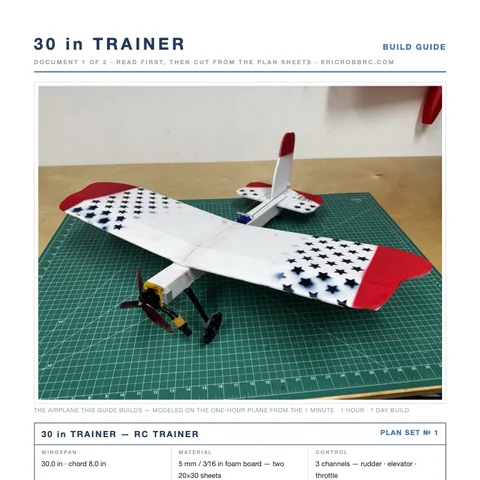 ER Sparrow Mk II Pre-Cut KitEvery foam part laser-cut and scored, the motor mount, the skewers, and the plans. Add your electronics and glue.$29.99See the kit →
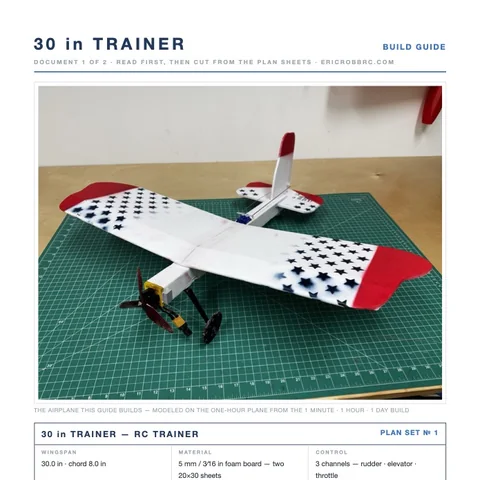 ER Sparrow Mk II PlansTrue-1:1 cutting templates and the 8-page build guide for the 30-inch one-hour trainer. Print at home or at a print shop.$8Get the plans →
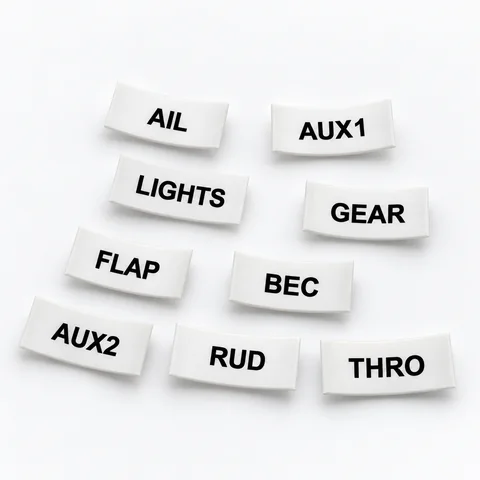 Servo Lead Heat-Shrink LabelsAIL, ELE, RUD, THRO and the rest, shrunk onto the lead so the receiver bay reads itself. Four packs.from $19.99See the label kit →
