Nine times out of ten it's one of six things: reversed controls, a tail-heavy CG, a backwards prop, too much weight for the wing, oversized control throws, or a weak power system — and every one is fixable on the bench, usually for free. After a lot of crashed foam board, I can tell you the symptom points straight at the cause. Tap what your plane is doing below and you'll get the reason and the fix.
Nine times out of ten an RC plane that won’t fly has one of six problems: reversed controls, a tail-heavy CG, a backwards prop, too much weight for the wing, oversized control throws, or a weak power system. Every one is fixable on the bench, usually for free — and the symptom points at the cause.
Pick the closest symptom — each answer is the pattern I see most, with the bench fix.
Symptom not here, or the fix didn't take? The Flight Doctor is the interactive version — describe your plane in your own words and it works out the actual cause.
Here is that same symptom-to-cause loop on one of my own planes: a foam board flying wing that would not fly through four attempts, until one small change turned it into a smooth flyer. The full build is here: I Almost Gave Up on My Homemade RC Plane.
This page covers the six classics. The Flight Doctor asks about your specific plane — what it did, when, and after what change — and walks you to the exact cause, with the fix and the tools to prevent it.
Say your 30-inch plane with an 8-inch chord keeps zooming up, stalling, and flopping over — classic tail-heavy behavior. The numbers: a safe CG on an 8″ chord is 25–30%, so 2.0″ to 2.4″ behind the leading edge. If it balances at 3.5″ — that's 44% of the chord, deep in dart territory. The fix cost nothing: slide the battery as far forward as the bay allows and re-balance on the marks. If it still won't come forward enough, glue coins to the inside of the nose. Tail-heavy is the one balance error that no pilot skill can fly around, which is why I check it before every maiden.
That zoom-stall-flop cycle is the tail-heavy signature — no amount of pilot skill flies around it. Slide the battery forward, re-balance on the marks, and the same plane flies a straight line.
This is what's happening at the top of that zoom: the plane trades speed for nose-up until the wing passes the angle the air can follow. The flow on top lets go, the swirls take over, and the lift quits — that's a stall. It's an angle, not a speed — which is why a tail-heavy plane can stall out of a full-throttle zoom, and why a gentle lob that points the nose at the sky stalls two seconds after launch.
The plane crashes, it gets picked up, and it gets thrown again — same settings, same balance, same result, one more broken prop. A crash is data: something was wrong, and it's still wrong. Before the next toss, run the 30-second check from behind the plane — stick back raises the elevator, stick right raises the right aileron, CG on the marks with the flight battery in, prop numbers facing the direction of flight (forward on a tractor prop). And if the plane has crashed before, flex-test the wings: foam board hides creases that cut a wing's strength in half, which is exactly how my slow flyer folded a wing mid-air days after a "minor" crash. Brand new to the hobby? The Start Here path builds these checks in from day one.
Found it and fixed it? Save the plane's numbers — CG, throws, battery, trim — on a one-page spec sheet so the next maiden starts from what works.
The airplane this site is built around, as plans or cut for you, and the small parts I use on every build.
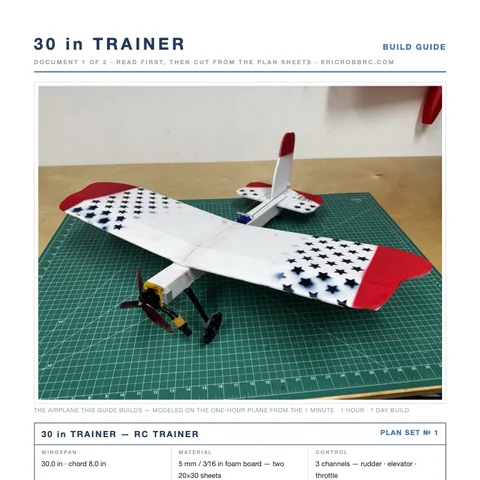 ER Sparrow Mk II Pre-Cut KitEvery foam part laser-cut and scored, the motor mount, the skewers, and the plans. Add your electronics and glue.$29.99See the kit →
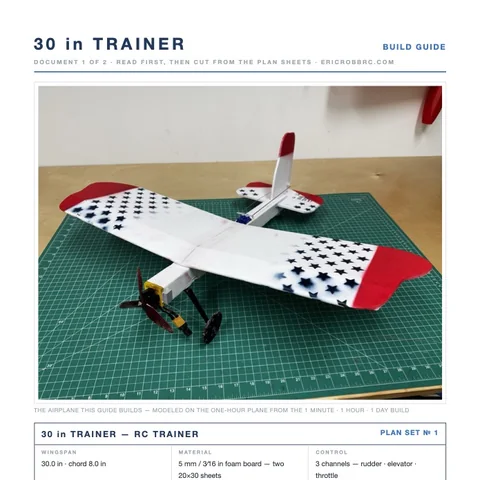 ER Sparrow Mk II PlansTrue-1:1 cutting templates and the 8-page build guide for the 30-inch one-hour trainer. Print at home or at a print shop.$8Get the plans →
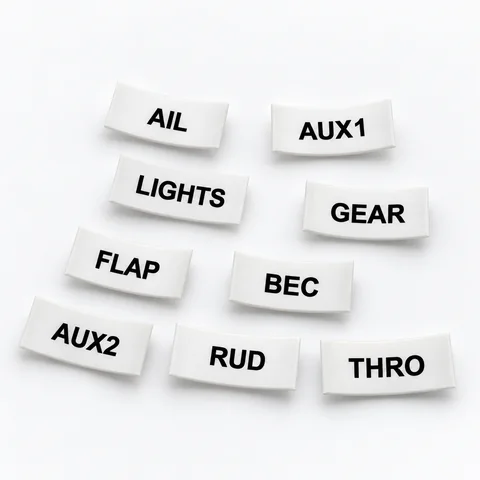 Servo Lead Heat-Shrink LabelsAIL, ELE, RUD, THRO and the rest, shrunk onto the lead so the receiver bay reads itself. Four packs.from $19.99See the label kit →
