It took about twenty minutes, it looks like a powered dinner plate, and it flies far better than it has any right to. This is the whole thing explained from the ground up: where a flat circle finds its lift, what those little fins on the edges are really for, why it doesn’t tumble like a thrown frisbee, and what every servo, wire and switch on board is doing while it’s up there.
A circle flies for exactly the same reason any wing does: it meets the air at an angle, throws air downward, and the air pushes back. No airfoil required. What makes the shape work is area — a circle packs about three times the wing area of a conventional wing of the same span, so it flies slowly and forgives almost everything.
Eric says it in the video almost in passing: “even though this thing looks ridiculous, it still needs basics — lift, stability, control and power.” That isn’t a throwaway line, it’s the entire design brief for every aircraft ever built. A 747 and a foam pancake are solving the same four problems with wildly different budgets. So that’s how this page is organised: four problems, in the order they have to be solved, with the circle as the worked example.
A wing works by throwing air downward. Every second it flies, the wing grabs a mass of air and pushes it down, and Newton’s third law does the rest — that air pushes the wing up by exactly as much. You’ll also hear lift explained through pressure, with the air over the top moving faster and its pressure dropping so there’s more push underneath than above. Both are true. They’re the same flow described from different ends.
Nothing in that requires a teardrop-shaped airfoil. A flat plate tilted into the wind deflects air down, so a flat plate is a wing. Almost every foam-board plane on this site flies on flat plates. A proper curved airfoil simply does the job more efficiently and stalls more gently — an optimisation, not an entry requirement.
Lift = ½ × air density × speed² × wing area × lift coefficient. Four dials, and you only get to turn three of them:
A circle wins on the second one, and it wins big.
This one is 30 inches across, so its area is π × 15² — 707 square inches, or 4.9 square feet. Now put it next to the two other 30-inch planes on this site, both of which have exactly the same span:
| 30-inch plane | Wing area | Aspect ratio |
|---|---|---|
| This circle | 707 in² (4.9 ft²) | 1.27 |
| ER Sparrow trainer (30 × 8) | 240 in² (1.7 ft²) | 3.8 |
| ER Moth slow flyer (30 × 6.75) | 203 in² (1.4 ft²) | 4.4 |
Same span, and the circle carries about three times the trainer’s wing and three and a half times the slow flyer’s. It fits in the same box on the bench and it is a fundamentally bigger wing.
Wing loading is weight divided by area, and it is the single most important number in how an airplane behaves. Three times the area for a similar weight means roughly a third of the loading, which means a much slower flying speed. At the same weight and the same lift coefficient, stall speed scales with the square root of wing loading, so a third of the loading is about 42% slower through the air.
Slow is what makes a twenty-minute build survivable: everything happens at a pace a human can react to, and when it does hit the ground it arrives with a fraction of the energy.
That’s the real answer to “how does this thing fly?” It isn’t that a circle is a clever wing. It’s that a circle is an enormous wing.
Eric hasn’t put this one on a scale, so here is the conversion rather than a claim. Divide the weight by 4.9 square feet:
| If it weighs… | Wing loading | For comparison |
|---|---|---|
| 8 oz | 1.6 oz/ft² | ER Moth slow flyer: 6.6 oz/ft² measured ER Sparrow trainer: about 10 oz/ft² |
| 10 oz | 2.0 oz/ft² | |
| 12 oz | 2.4 oz/ft² | |
| 14 oz | 2.9 oz/ft² |
The useful thing about that table is that the conclusion doesn’t depend on guessing the weight. Anywhere in that range, the circle is flying at less than half the slow flyer’s loading and under a third of the trainer’s — and the slow flyer is a plane built specifically to fly slowly. A foam pancake thrown together in twenty minutes has a lighter wing loading than the airframe designed for it.
Aspect ratio is span² divided by area — long and skinny scores high, short and stubby scores low. For a circle the span is the diameter D and the area is πD²/4, so the aspect ratio works out to 4/π. The D cancels completely. Every circular wing ever cut, at any size, has an aspect ratio of about 1.27.
Three things follow from sitting at the bottom of that chart:
Induced drag is the price you pay for making lift — the energy left behind in the swirling air coming off the edges of the wing. The usual shorthand is that low aspect ratio means terrible induced drag. Look at the actual relationship, though:
Induced drag = weight² ÷ (½ × density × speed² × π × span² × efficiency)
Read the bottom of that fraction again. Span, squared. Not area, not planform, not aspect ratio. What decides the bill is how wide a slice of air you spread the downwash across. A circle 20 inches across and a conventional wing 20 inches across, carrying the same weight at the same speed, leave behind roughly the same swirl and pay roughly the same induced drag.
So where does the circle actually lose? Profile drag — skin friction and form drag — which does scale with area. Three times the area is about three times that penalty. The circle buys its lift bargain with surface, not with swirl.
The textbook ideal lift distribution for a simple wing is elliptical; it’s the reason a Spitfire’s wing is shaped the way it is. Measure a circle’s chord — the front-to-back distance — at each point across the span, and the distribution you get is exactly elliptical. It is the same planform as a Spitfire, squashed from an aspect ratio of about 5.6 down to 1.27.
The catch is that the theory calling elliptical “ideal” assumes a long, slender wing. At 1.27 those assumptions come apart, the flow around the rim goes thoroughly three-dimensional, and real efficiency falls short of what the maths promises. It’s still a pleasing coincidence: the dumbest-looking wing on the internet shares its planform with one of the most admired.
Eric folds the edge of the disc up “to give it some shape.” Two separate things are happening there.
Structure, mostly. A flat sheet of foam is floppy — it bends easily about any line you draw across it. Fold the edge up and you’ve created a flange, and a flange resists bending enormously better, because you’ve moved material away from the axis it would bend around. It’s why you curl a floppy slice of pizza before you bite it, and why a paper plate has a rim. The foam didn’t get stronger; the geometry did.
Aerodynamics, as a bonus. An upturned lip is a small endplate running the whole way around, getting in the way of air trying to spill from the high-pressure underside to the low-pressure top. It also gives the outer edge a hint of dihedral, which helps in roll.
A frisbee is a wing, and a thrown frisbee is stable — but not the way an airplane is. A frisbee is a gyroscope: it spins fast, and spinning things resist being tipped over. Stop the spin and a frisbee tumbles instantly.
This plane doesn’t spin. So every bit of its stability has to come the airplane way, and that means fixing three separate axes.
All the lift on a wing can be summed into one force acting at one point, called the aerodynamic centre. If the centre of gravity sits ahead of that point, the airplane is stable in pitch: let the nose rise and the extra lift, acting behind the CG, pushes it back down. Put the CG behind it and every little disturbance grows instead of fading. Nose-heavy flies badly. Tail-heavy doesn’t fly.
The tail earns its keep twice. It adds a surface a long way behind the CG, which damps pitching motion, and it drags the whole airplane’s neutral point rearward, which widens the range of CG positions you’re allowed to use.
On this plane the heaviest single item is the battery, and Eric mounted it so it slides fore and aft. That’s the balance control. The relationship is the same one that decides a 54-pound airplane: the CG moves by the mass you shifted, times how far you shifted it, divided by the total weight. On something that weighs a few ounces, an inch of battery travel is a lot of centre of gravity. (For the same arithmetic at the other end of the scale, see what nine pounds of nose ballast cost the 20-foot plane.)
“A nice little big rudder so it will help it track straight.”
Put a vertical surface behind the centre of gravity and you’ve built a weathervane. Let the nose swing left and that fin is suddenly meeting the air at an angle, which generates a sideways force on the tail and swings it back into line. The strength of the effect is simply the fin’s area multiplied by how far behind the CG it sits.
A circle has almost no side area behind the CG to begin with, and the motor pod sticking out in front actively works against you — side area ahead of the CG is destabilising in yaw, because it pulls the nose further into any swing. So the fin isn’t decoration. Without enough of it the plane hunts from side to side, which is the “confused paper plate” the video warns about.
This is the part everybody asks about — the small vertical surfaces standing up near the outer edge. They’re doing three jobs at the same time.
A control surface is a hinged flap on the back of a fixed surface. Deflect it downward and the whole surface behaves as though it had more curvature built into it, so it makes more lift in that direction. That extra force, acting at some distance from the centre of gravity, rotates the airplane. Every control on every aircraft is that same idea:
Force times distance. That’s the entire language of control.
“This thing flips, spins and turns way faster than I expected. Actually kind of scary for something I built in 20 minutes.”
That’s geometry, not luck. On a circle the tail bolts straight onto the back of the disc, so the distance from the centre of gravity to the tail is short — and two different things depend on that distance in two different ways. Control power scales with the arm. Pitch damping scales with the arm squared. Halve the distance and you halve the control authority, but you quarter the damping.
So you get an airplane that responds immediately and then keeps on going, because there’s very little behind it to settle the motion down. Add a tiny, light airframe — which means very little rotational inertia to overcome — and quick, under-damped and slightly alarming is exactly the flight behaviour you should expect.
The servo never touches the control surface. A pushrod runs from an arm on the servo to a horn on the surface, and that pair of levers is a gear ratio you choose when you build it:
Getting this wrong is the most common reason a new plane feels awful. Too much throw makes it uncontrollably sensitive; too little and it won’t turn. Slop is the other one — any free play in the linkage shows up as a dead zone right around centre, exactly where you need precision most.
“It’s a little rocky, but after some trim it starts flying way better than expected.”
Trim is a permanent offset added to a surface’s neutral position. If the plane climbs with the stick centred, a few clicks of down trim redefine what “centred” means. Doing it from the transmitter takes a second in the air; doing it by shortening or lengthening the pushrod is the permanent fix, and it’s the right one if you’re holding more than a handful of clicks. A plane that needs a lot of trim is telling you something about its centre of gravity or its surface alignment, and trim only hides the message.
A brushless outrunner is two parts: a fixed core of copper windings in the middle (the stator), and a rotating can carrying permanent magnets around the outside. “Outrunner” means the outside is what spins. There are no brushes and no commutator, so nothing rubs and nothing wears out.
Two numbers matter on the label. Kv is revolutions per volt with no propeller fitted — a 1000Kv motor on an 11.1-volt pack wants about 11,100 rpm unloaded, and rather less once a propeller is fighting it. Watts is how much power it can turn into thrust before it starts cooking itself. The mental model worth keeping: voltage buys rpm, current buys torque. Fit a bigger propeller and you’ve asked for more torque, so it draws more current at the same voltage.
The electronic speed control has the hardest job on the airplane, and it’s really doing three at once.
And there’s a fourth job it does quietly: the BEC, a little step-down converter that makes a clean 5 volts or so for the receiver and the servos out of the full pack voltage. It’s the part builders forget about until it runs out — on the 20-foot plane, an 8-amp BEC is the best explanation we have for why it stopped responding.
A servo is a tiny closed-loop position controller in a plastic box. Open one and you find four things: a small DC motor, a gear train, a potentiometer geared to the output shaft, and a control board.
The receiver sends it a pulse about fifty times a second, and the width of that pulse is the command: 1.0 millisecond for one end of travel, 1.5 for centre, 2.0 for the other end. The board compares that command with what the potentiometer says the output shaft is actually doing, and drives the motor in whichever direction closes the gap. When the two agree, it stops. That loop never stops running, which is why a servo pushes back if you try to move the surface by hand.
Three practical consequences:
Lithium-polymer cells are 3.7 volts nominal each, so “3S” means three in series, about 11.1 volts. Capacity is in milliamp-hours — the size of the tank. The C rating is how fast the pack can safely be emptied: multiply C by capacity to get the maximum current it will stand.
On an airplane this light the battery is also the heaviest single object on board, which is exactly why it’s sitting on rails. It’s the fuel tank and the balance weight at the same time.
The parts list is a 2208-class motor at 2300Kv, a 5-inch prop, a 30 A ESC and a 3S 1300 mAh pack. Run that through the arithmetic above and a few things fall out.
And here is the whole airplane in one sentence. It has the wing loading of a slow flyer and the power loading of an aerobat. Those two facts, sitting in the same airframe, explain everything Eric says about how it flew: it floats, because there is an enormous wing under almost no weight — and it snaps, because there is a lot of power, almost no rotational inertia, and a very short tail arm behind it. “Flips, spins and turns way faster than I expected” isn’t surprising at all once the numbers are on the table. It’s the only way a plane with this combination could possibly behave.
One more detail worth noticing: the prop is tiny relative to the plane — 5 inches across a 30-inch span, where a conventional 30-inch build swings 8 or 9. A small fast prop makes its thrust by throwing a little air very quickly instead of a lot of air gently, which is efficient at speed and wasteful when slow. On a wing this big, a bigger, slower prop would be the efficient choice. It would also make the plane a great deal less exciting.
Everything on this page converges on one number: wing loading. A circle is very nearly all wing. Spread the weight over that much area and it flies slowly, and slow forgives almost everything — a centre of gravity that isn’t quite right, a rough launch, control throws that are too big, and a landing that’s more of an arrival. The airplane has time to be wrong and recover. So do you.
It’s the same reason the first-plane guide here is a 30-inch foam trainer and not a scale warbird. For a first flight, loading beats craftsmanship every single time.
The video ends by asking, and the engineering answer is that shape is very nearly free. What an airplane genuinely demands is a short list:
Satisfy those five and something that looks completely absurd will fly. Miss the second one and the most beautiful wing you have ever built will not leave the ground.
The setup on this one is in the table near the top of the page. None of it is shape-specific — you size the electronics to the weight and the wing area, whatever outline you cut — so these tools will do it for any diameter you like:
| Pick the size | The Airplane Designer takes a wingspan and gives you dimensions, a balance point and a parts list. Enter your circle’s diameter as the span. |
| Pick the electronics | The Electronics Checklist Builder matches a motor, ESC, battery, prop and servos that work together instead of guessing part by part. |
| Wire it | The Wiring Designer draws exactly what plugs into what for your battery and servo count, and the wiring guide covers the hookup order that won’t damage anything. |
| Find the balance point | The CG calculator. On a circle, treat the diameter as the chord and start well forward of the middle — a stubby wing’s aerodynamic centre moves around more than a normal one’s. |
| Start from a known-good plane | If this is your first build, the ER Sparrow guide has measured dimensions, a printable cut guide and the exact parts — then come back and cut something ridiculous. |
17 September 2026: added the setup Eric actually flew — 30-inch circle, 2208-class 2300Kv motor, 5-inch prop, 30 A ESC, 3S 1300 mAh pack, 9 g servos — plus the wing area, loading and power numbers that follow from it. The one number still missing is the all-up weight, which is why the loading appears as a conversion table rather than a single figure; nothing here is presented as a measurement Eric didn’t take. Spot something off in the maths or the physics? Tell me and I’ll fix it.
Auto-transcribed from the video, so expect the odd mis-heard word. Here so you can search or skim what was said without watching.
This is me trying to turn a foam circle into an RC airplane. Not a normal wing, not a normal fuselage, basically a foam pancake with a motor. And the question is simple, can I make this thing fly or did I just build a powered dinner plate? So first I'm cutting out the main circle, the tail and the motor pod. Even though this thing looks ridiculous, it still needs basics, lift, stability, control and power. Then I start cutting everything out of the foam. The circle is the main body of the plane, but by itself it wo
uld probably fly like a frisbee with commitment issues. So I'm folding up the edges a little bit to give it some shape and hopefully make it more stable in the air. Next I glue on the tail, which this should keep the plane pointed forward instead of wandering around the sky like a confused paper plate. Now I'm building the power pod. This holds the motor and the electronics. I'm making it removable so I can still get inside if something break, which with a plane like this feels pretty likely. Once the motor is moun
ted, I start adding the servos and control linkages. These are what let me steer the plane because without them I'm basically throwing a powered circle and hoping for the best. Now I wire up the receiver and test the controls. Everything is moving in the right direction, which means this bad idea is getting dangerously close to working. Next I add the support mounts for the power pod and slide skewers to lock them in place. It's simple, lightweight and hopefully strong enough to at least fly one flight. See, it wor
ks. We've got our little power pod down here. We've got our battery mounted here up front. We can move it back and forth for center of gravity. We've got our motor up here and servos there. We've got these things here so that it will like help it be stable in the air. We've got a nice little big rudder so it will help it track straight and it should be good. So let's get it in the air and see how it flies. I'm trying to get to 100,000 subscribers at some point, maybe by the end of this year if you guys really want
to go crazy. But if you like this video, please hit that subscribe button. It would really mean a lot to me. And somehow it actually flies. And since it's a little rocky, but after some trim, it starts flying way better than expected. It tracks straight, turns clean, and once in the air, it honestly looks less stupid than it did on the table. Then, I started pushing it harder. This thing flips, spins, and turns way faster than I expected. Actually kind of scary for something I built in 20 minutes. This circle can f
ly. Not gracefully, not normally, but way better than it had any right to. And now I need to know, what shape is actually too dumb to fly? Let me know in the comments. So, the final test is simple. Can I land it without turning it back into a scrap foam? Yeah! Woohoo! It's always good when I can end a video with an intact plane. This is such a fun project. Go check out my channel if you want to see more of these crazy short builds, and I will see you in the next one. Adios.
The airplane this site is built around, as plans or cut for you, and the small parts I use on every build.
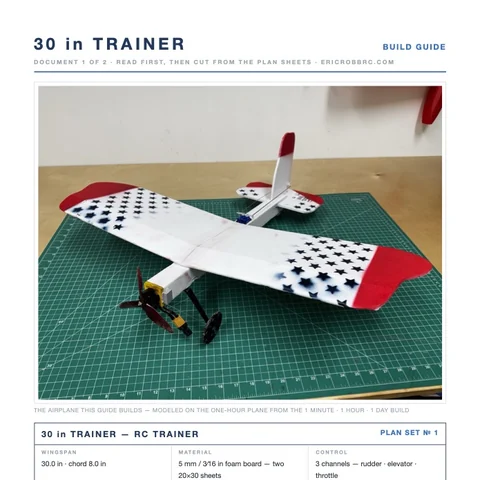 ER Sparrow Mk II Pre-Cut KitEvery foam part laser-cut and scored, the motor mount, the skewers, and the plans. Add your electronics and glue.$29.99See the kit →
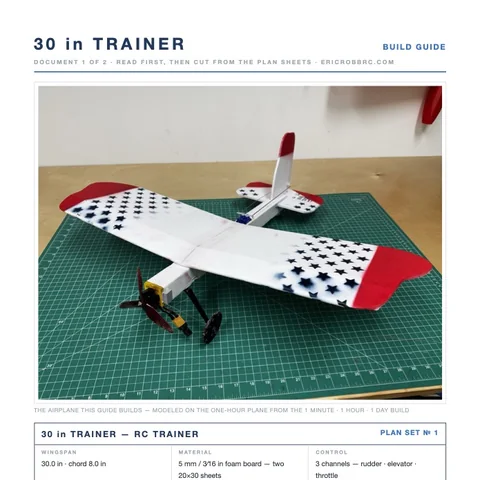 ER Sparrow Mk II PlansTrue-1:1 cutting templates and the 8-page build guide for the 30-inch one-hour trainer. Print at home or at a print shop.$8Get the plans →
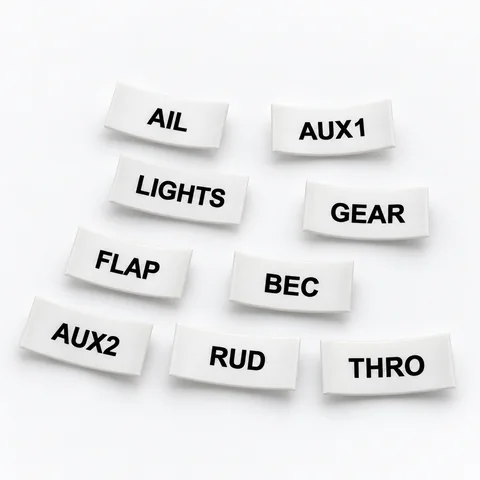 Servo Lead Heat-Shrink LabelsAIL, ELE, RUD, THRO and the rest, shrunk onto the lead so the receiver bay reads itself. Four packs.from $19.99See the label kit →
